Web Design for HVAC Companies
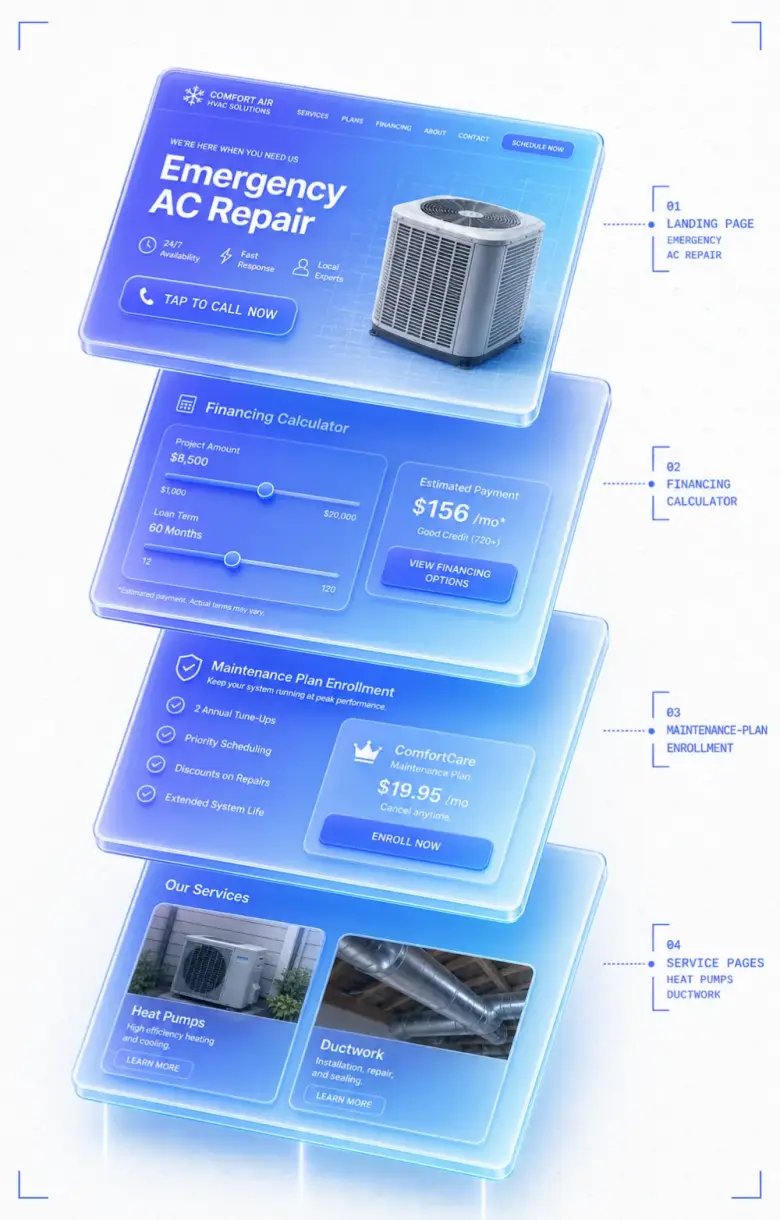
HVAC is two businesses on one website: the homeowner whose AC died at noon in July and the homeowner planning a $12,000 system replacement next spring. We build HVAC websites that serve both — emergency-service pages with sticky click-to-call, maintenance-plan pages that build recurring revenue, financing pages that close $10K+ tickets, plus service pages for AC repair, heating, mini-splits, heat pumps, ductwork, and indoor air quality. Built for $100. $25/month for hosting and maintenance.
When the AC Dies in July, Your Website Is Where the Money Is Made
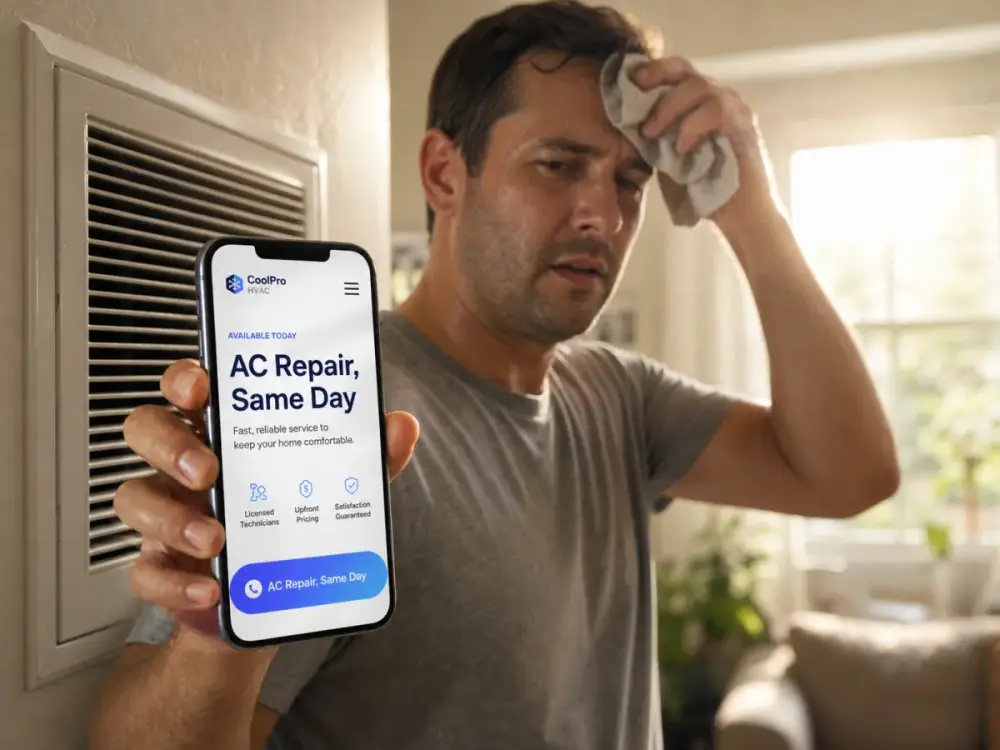
HVAC is one of the most seasonally compressed trades there is. In late July when temperatures hit triple digits, the average homeowner with a dead air conditioner makes a hiring decision in under an hour. They Google “AC repair near me,” they call the first three companies that load fast, and they hire whichever one can be at their door soonest. The same compression happens in January when furnaces fail, and again in spring and fall during maintenance-tune-up season. If your HVAC company doesn’t show up in those critical Google moments, you don’t just lose one job — you lose the entire seasonal pipeline, plus every recurring maintenance plan that would have come from it.
HVAC search behavior is unlike most other trades. Customers spend more time researching before calling because the jobs are higher dollar. A new system install runs $5,000 to $15,000+. A heat-pump conversion can hit $20,000. Financing matters. Brand matters. Warranty matters. Customers Google your business name after they find you, looking for reviews, certifications, and how long you’ve been in business. Your website is the second decision point — the first was the local pack — and it either closes the lead or sends them back to the search results to try someone else.
The HVAC trade also has the most aggressive recurring-revenue model in home services. A good maintenance plan customer is worth $300 to $600 a year, every year, for as long as they own the house. The website is what sells those plans — not the truck wrap.
What Happens When Your HVAC Company Has No Real Website
- You lose every emergency call to the company with the better mobile site. AC and heating emergencies are mobile, urgent, and impatient. Slow load = lost call. Slow mobile pages tend to lose impatient callers before the page even finishes loading.
- You can’t sell financing properly. A $12,000 system replacement is often a financing decision, not a cash decision. Without a dedicated financing page that explains payments, terms, and how to apply, customers default to whichever competitor makes it easy to understand.
- You can’t build a maintenance-plan book. Maintenance plans are the most lucrative part of HVAC, but they require a clear page that explains what’s included, what it costs per month or per year, and how to sign up. A Facebook post can’t sell that.
- You miss the cross-shopping homeowner. Big-ticket HVAC customers often get three quotes. If two of the other companies have polished websites with brand certifications and project photos, and yours is a Facebook page, you lose on perceived legitimacy alone.
- Commercial accounts ignore you. Property managers, facility directors, and restaurant owners need a regular HVAC vendor. They will not consider a company without a website showing insurance, certifications, response times, and commercial work proof.
What Customers Actually Want to See on an HVAC Website
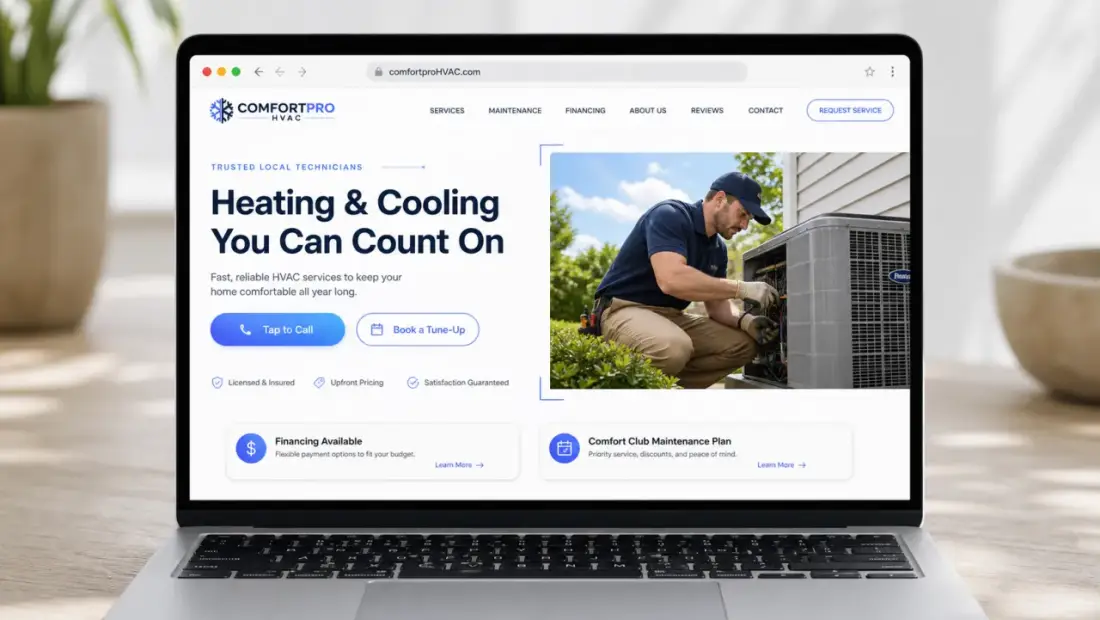
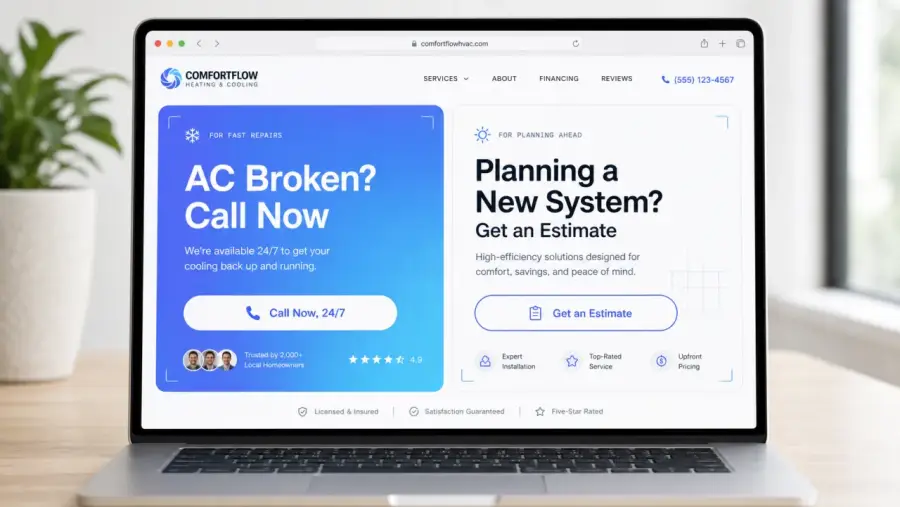
HVAC customers are doing two different jobs depending on the season and the situation: emergency-finding (system died, need someone now) or research-shopping (planning a replacement, getting bids). A good HVAC site has to serve both without confusing either. Here’s the structure that works:
Two-Track Hero Section
One clear path for “my AC is broken now” (big phone number, click-to-call, response time promise) and a second clear path for “I’m planning a new system” (estimate form, financing info, brands you carry). Both visible above the fold.
Service Pages for Every Major Job
AC repair, AC installation, heating repair, heating installation, heat pump installation, mini-split installation, ductwork, indoor air quality, thermostats, commercial HVAC. Each gets its own page that targets the actual search behind it.
Maintenance Plan Page That Actually Sells
Explains what’s included (tune-ups, priority dispatch, discounted repairs), what it costs, what the savings work out to, and how to enroll online. This single page can be worth six figures a year in recurring revenue if done right.
Brands and Certifications
NATE certification, EPA 608, brand-dealer status (Trane Comfort Specialist, Carrier Factory Authorized, Lennox Premier, etc.), BBB rating, years in business. Customers spending $10,000 on a new system want to see all of this before they call.
Financing Page
If you offer financing, it gets its own page. Covers terms, rates, how to apply, and what kinds of systems qualify. Customers who understand financing convert 2 to 3 times faster than customers who think they have to pay cash.
Service-Area Pages
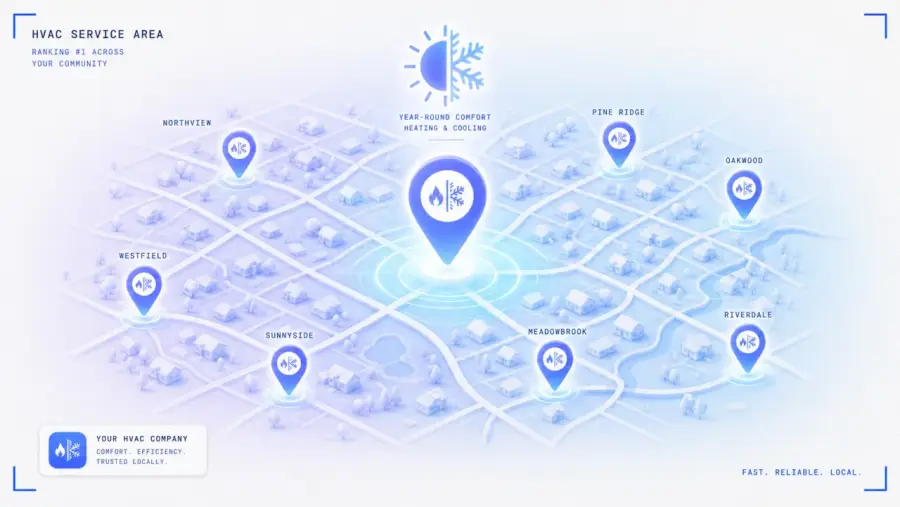
One page per town, suburb, or zip you serve. Ranks you for “HVAC company in [town]” — the exact searches your highest-intent customers make when they want a local company they can drive past on the way home.
Service Pages That Help You Rank for Searches That Actually Convert
HVAC has a huge search universe. Most of it is split between emergency-intent searches and planning-intent searches. We map your services to the pages that will earn the most traffic and the most qualified leads:
- AC repair [city]. The single most-searched HVAC term in summer. Bookings convert fast. Often the gateway to a maintenance-plan upsell.
- AC installation / replacement [city]. Premium customers, premium tickets ($5K to $15K). Page should cover sizing, brand options, SEER ratings, and financing.
- Heating repair [city] / furnace repair [city]. Winter equivalent of AC repair. Same urgency, same conversion pattern.
- Furnace installation / heating system replacement. Often paired with AC replacement in a full-system change-out.
- Heat pump installation. Rapidly growing search category as homeowners electrify. Federal tax credits drive demand. Page should cover the IRA incentives.
- Mini-split installation. Premium niche — additions, garages, sunrooms, ductless retrofits. High margins, lots of research-phase customers.
- Ductwork repair / duct cleaning. Often comes up as a secondary issue during a service call — but on the website it’s a standalone search worth ranking for.
- Indoor air quality / air purifier / UV light. Recurring add-on revenue and a fast-growing search category since 2020.
- Maintenance plan [city]. Typically one of the strongest-performing pages on the site. Customers who land here are pre-sold; the page just has to close them.
- Commercial HVAC. Different audience, different tone. Worth its own page if you bid restaurant, retail, or property-management contracts.
Local SEO for HVAC Companies: How We Set It Up
- Service-specific title tags. Every service page targets a real search. “AC Repair in [City] — Same-Day Service” instead of generic “Services.”
- HVACBusiness / LocalBusiness + Service schema. Machine-readable structured data telling Google your name, address, phone, hours, service area, and full service list.
- NAP consistency. Identical name/address/phone formatting across the site, Google Business Profile, Yelp, BBB, Angi, HomeAdvisor, and the HVAC trade directories.
- Google Business Profile alignment. Your GBP service categories match your site’s navigation. Reviews surface on both.
- Tested against Core Web Vitals before launch. HVAC customers are mobile-first; slow load measurably hurts call conversion.
- Seasonal content. The site is set up so seasonal pages (pre-summer AC tune-up, winterization, holiday emergency hours) can be spun up quickly when the season turns.
- Internal linking across services. AC repair links to maintenance plans, maintenance plans link to financing, financing links to AC installation. The customer journey is mapped into the site structure.
What a New HVAC Website Is Actually Worth
Here’s a simple illustration (not a prediction — your results depend on your market, reviews, pricing, and many factors outside the website). HVAC is one of the highest-revenue-per-customer trades, which means even modest lead-volume increases compound fast. If the website brings in two extra service calls per week at an average ticket of $350, that’s $2,800 a month or $33,600 a year. Add one extra system replacement per month at $9,000, and you’re at $141,600 in incremental annual revenue from a $100 build and $25-a-month maintenance fee. The maintenance plan book layered on top compounds for years — a healthy 200-customer maintenance book at $25/month is $60,000 a year in recurring, predictable income.
The bigger jobs — new systems, heat pumps, full ductwork — almost always come from website research, not referrals. Those customers don’t want to call until they’ve seen your reviews, your brand certifications, and your install photos. A polished site is the cost of being in the conversation.
Why Most Web Designers Overcharge HVAC Companies
The agency quotes HVAC companies get usually run $4,000 to $12,000 up front, plus $100 to $250 a month. Some agencies that specialize in HVAC charge even more, often packaging the site with mandatory monthly “SEO retainers” of $1,500 to $3,000. The pricing reflects what HVAC companies have historically been willing to pay — not what the work costs to deliver. The actual website-build work is the same across trades.
We do it differently. The build starts at $100. Hosting, security, backups, and software updates are $25 a month, month-to-month, no contract. You see a free homepage mockup before paying. Custom integrations (with ServiceTitan, FieldEdge, Housecall Pro, etc.) are quoted separately and only if you ask.
Frequently Asked Questions
How does the site target “AC repair near me” searches?
Can the site sell maintenance plans automatically?
Do you display financing offers, like 0% APR promotions?
How should I handle being a Trane / Carrier / Lennox / etc. dealer on the site?
Can you build out service-area pages for every town we cover?
How long until the site starts ranking and producing leads?
What about seasonal pages, like “AC tune-up special” in May?
Let’s Build Your HVAC Website
Send the basics and we’ll be in touch with next steps for your free homepage mockup.
Tell Us About Your Business