Why It Matters

Roofing Is the Highest-Stakes Hire a Homeowner Makes

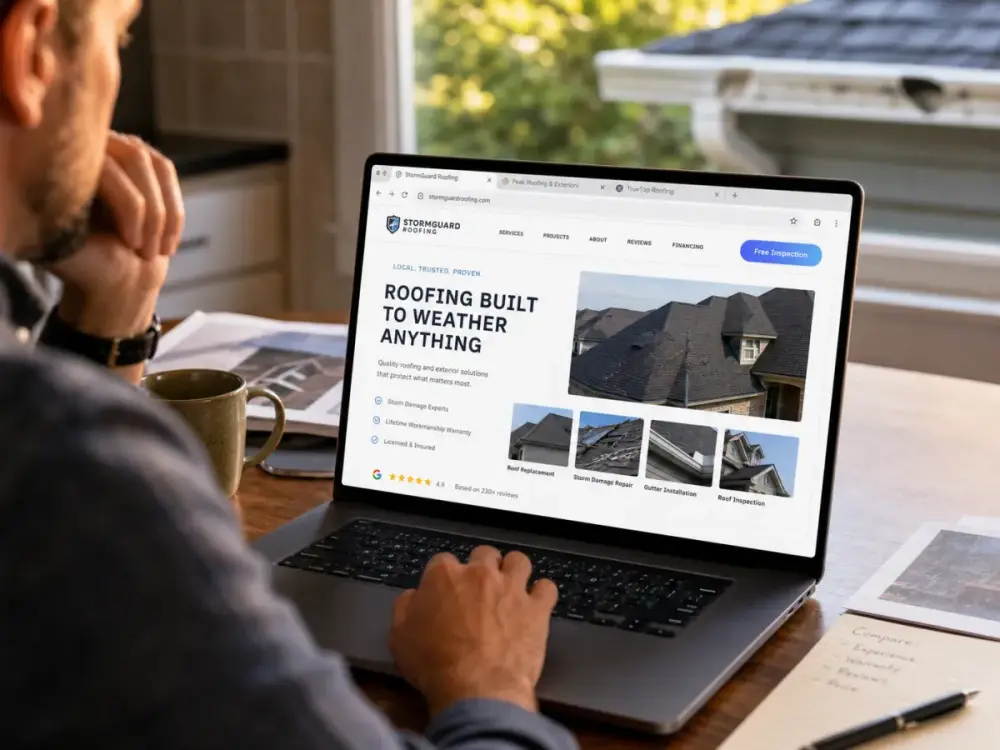
A new roof costs $8,000 to $25,000 on average, and a full storm-damage replacement on a larger home can push past $40,000. Homeowners do not write checks that big without research — lots of research. The average roofing customer gets three to five quotes, reads dozens of reviews, asks neighbors, and spends two to four weeks deciding. Your website is the second or third stop on that journey, and it either earns you a place on the bid list or sends them to a competitor. There is no in-between.

Roofing also has the most lopsided lead economics in the trades. Insurance work, storm work, and full replacements can run six figures over a season. A single deal can be worth more than an entire month of small repairs. That means even one extra closed job per quarter from a polished website pays for the website for the next decade. The math is so dramatic that not having a real website is closer to financial malpractice than a stylistic choice.

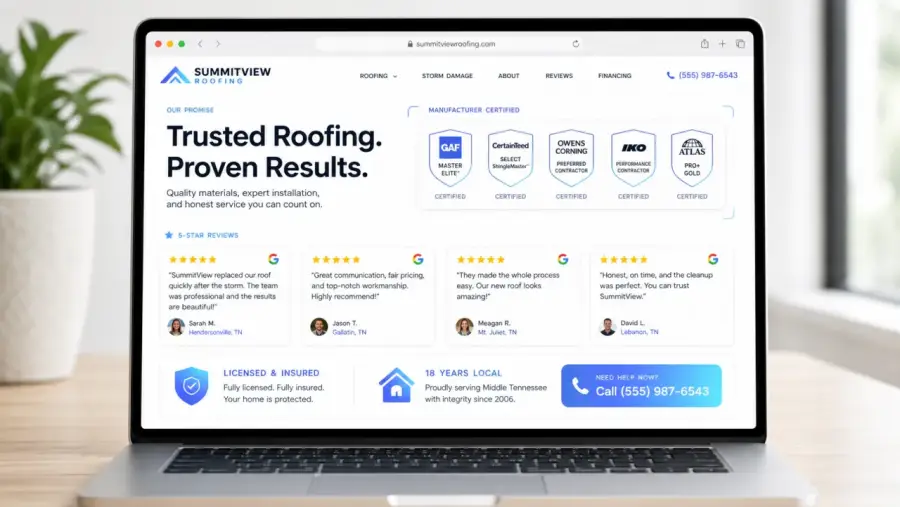
And then there’s the out-of-state-contractor problem. After a hailstorm, every roofing market sees an influx of unfamiliar crews that knock doors, pull permits, do quick work, and leave town before any warranty question comes up. Your website is the single most-important way a local, established roofing company differentiates itself. License, insurance, years in business, local project photos, real Google reviews from named customers in named towns — that’s what separates a trusted local roofer from an unknown out-of-state outfit.

What Happens When Your Roofing Business Has No Real Website

  • You don’t make the bid list. Roofing customers compare 3+ companies. The website is the qualifier. If you don’t have one or it looks worse than the competition, you never even get the call.
  • You lose to out-of-state crews. The unfamiliar crew with a hastily-built one-page site still has something for customers to look at. A Facebook page doesn’t compete — it makes you look like a hobbyist.
  • You can’t prove your work. Roofing is visual. Before-and-after project galleries, drone shots, and material-specific photos are what close $15,000+ jobs. Facebook buries this; a website displays it permanently.
  • You can’t handle insurance claims efficiently. Insurance customers want to see that you understand the claims process, work with adjusters, and have done similar claims before. That’s a dedicated page on the website, not a sales pitch over the phone.
  • You miss the entire commercial flat-roof market. Property managers, GCs, and facility directors will not consider a roofing company without a website. TPO, EPDM, modified-bitumen — commercial roofing is a whole separate revenue stream, and the website is the gateway.

What Customers Actually Want to See on a Roofing Website

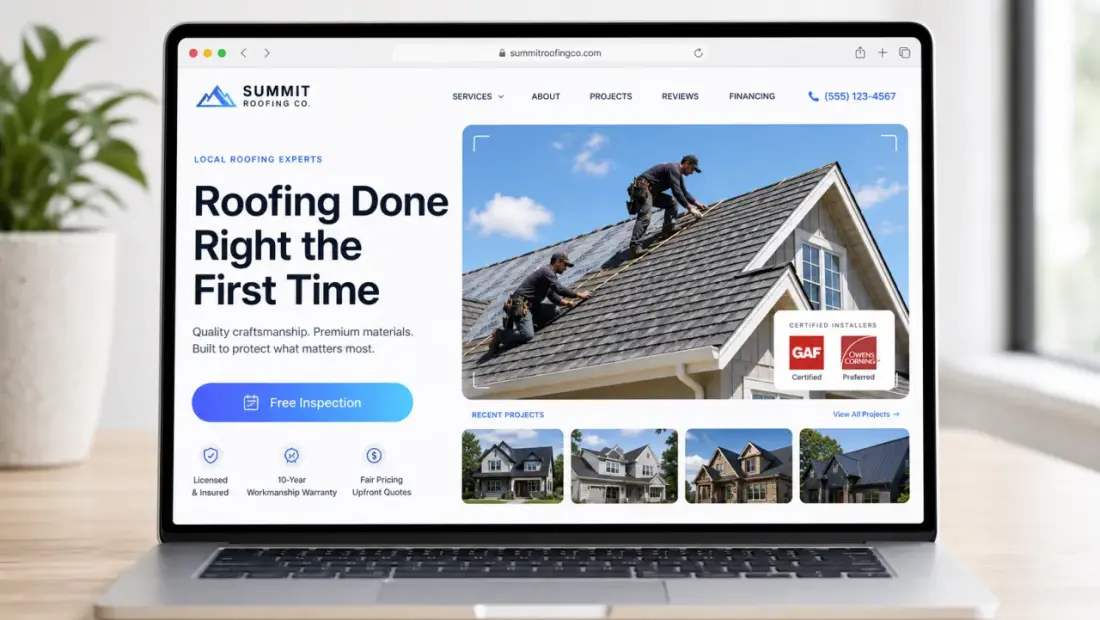
The roofing customer is doing a high-trust, high-research evaluation. Every section of your site has to be either reassuring them you’re legitimate, showing them you’ve done their kind of project before, or making it easy to take the next step. Here’s what every roofing site should have:

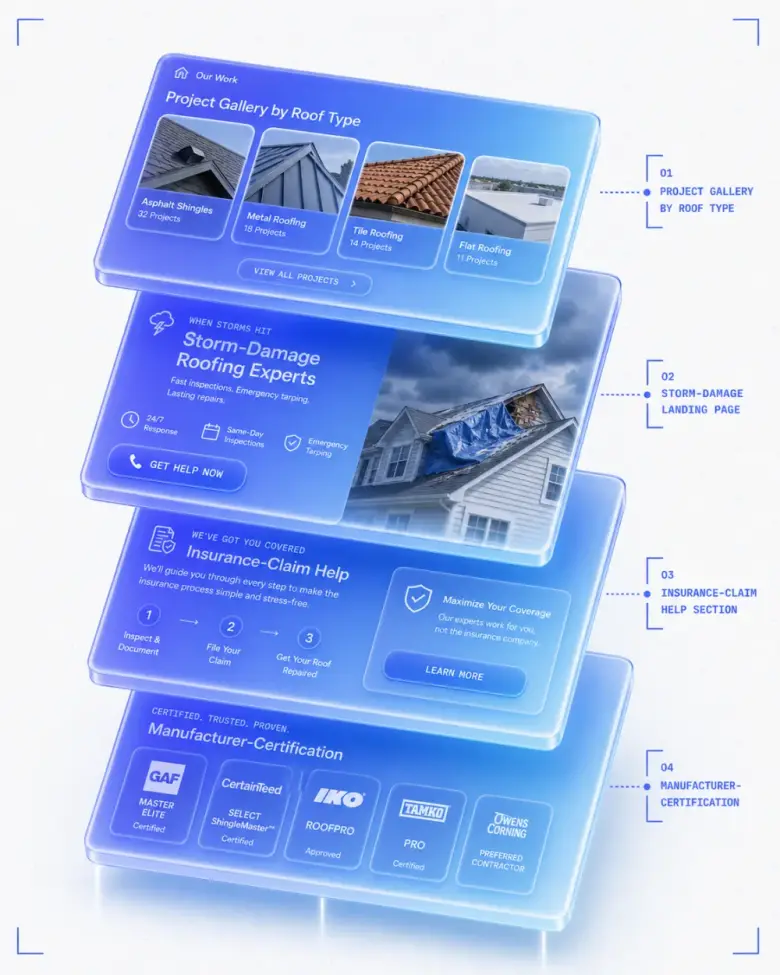
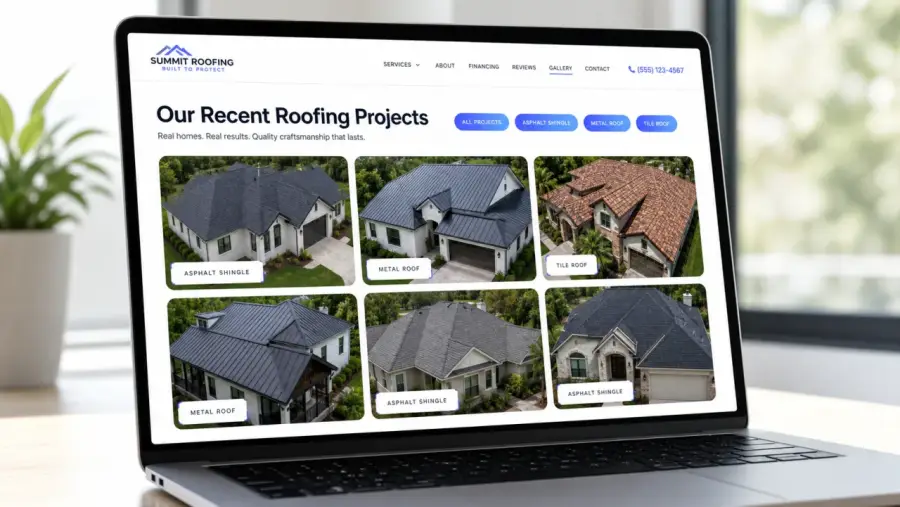
Project Gallery, Organized by Roof Type

Asphalt shingle replacements, metal roof installs, tile roofs, flat roofs, storm repairs. Customers want to see their kind of roof done well. We organize the gallery so they can click straight to it.

Storm Damage Page

One of the highest-intent search categories there is, especially in the weeks after a hailstorm. Page covers what storm damage looks like (with photos), how to file an insurance claim, and what to expect from the inspection process.

Insurance Claims Help Section

Walks customers through filing a claim, what an adjuster looks for, and your role in the process. Builds trust before the call. Customers who land on this page are usually 24 hours away from hiring someone.

License, Insurance, Bonding, Warranties

Roofing license, GL insurance amount, workers’ comp, manufacturer certifications (GAF Master Elite, Owens Corning Platinum, CertainTeed SELECT ShingleMaster), and warranty terms displayed clearly. These are the trust signals customers verify before calling.

Free Estimate Request Form

Short form: address, roof issue, when they need it done. Triggers an inspection scheduling sequence. Roofing estimates are usually free, and the page should say so prominently.

Reviews and Local Trust Signals

Google reviews surfaced prominently with full names and towns visible. Years in business. BBB rating. Affiliations with local builder associations or chamber of commerce. These are the signals customers use to choose between a local established roofer and an unfamiliar out-of-state crew.

Service Pages That Help You Rank for Searches That Actually Convert

The roofing trade has some of the most lucrative service-specific search terms in any home-service category. Each of these pages can be the source of dozens of high-ticket jobs per year if built and ranked properly:

  • Roof replacement [city]. The bread-and-butter premium search. Average job $8K-$25K. Page should cover material options, warranties, timeline, and process.
  • Roof repair [city]. Lower ticket ($300-$2,000) but high volume. Often the entry point before a replacement conversation later.
  • Storm damage roofing [city] / hail damage roof repair. Highest-intent search after a weather event. Spikes for 4-8 weeks after a storm, then drops.
  • Metal roof installation [city]. Premium customers, $15K-$50K+ jobs. Customers research for months. Long page with metal types, color options, longevity comparisons.
  • Tile roof / clay tile / concrete tile roofing [city]. Regional (Florida, Southwest, California). Premium material, long-lifecycle customer.
  • Flat roof / commercial flat roofing. TPO, EPDM, modified bitumen, PVC. Different audience (property managers), different copy, different proof points.
  • Insurance claim roofing [city]. Customers actively filing or about to file a claim. Page covers your role, what to expect, and what NOT to do (don’t sign with a door-knocker).
  • Roof inspection [city]. Often pre-purchase or pre-listing. Lower-ticket entry point, frequently leads to repairs or replacements.
  • Skylight / chimney / gutter add-on services. Cross-sell during a roof job. Each gets a small dedicated page.
  • Commercial roofing [city]. Restaurants, retail, industrial. Different audience, different sales cycle, different proof points (TPO experience, warranty, GC relationships).

Local SEO for Roofing Contractors: How We Set It Up

  • Roofing + LocalBusiness schema. Tells Google your service area, license number, service list, and certifications. Required for proper local-pack ranking.
  • Service-specific title tags. Each page targets a real search. “Roof Replacement in [City] — Free Estimates” instead of generic “Services.”
  • NAP consistency. Identical name/address/phone across the site, GBP, Yelp, BBB, Angi, HomeAdvisor, and roofing-specific directories (HomeAdvisor, Modernize, RoofingContractor.com).
  • Storm-content readiness. Templates ready to spin up storm-specific pages as soon as hail or wind event hits. Storm SEO is time-sensitive — first to publish wins.
  • Manufacturer certification displays. GAF, Owens Corning, CertainTeed, IKO, and others all provide schema, badges, and trust-signal assets we incorporate.
  • Service-area pages with real local detail. Each town page mentions actual neighborhoods, common roof types in that area, and any local storm history. Not generic.
  • Speed and mobile readiness. Optimized for Core Web Vitals. Roofing customers research on mobile; slow load = lost lead.

What a New Roofing Website Is Actually Worth

Here’s a simple illustration (not a prediction — your results depend on your market, reviews, pricing, and many factors outside the website). The math on roofing is the most lopsided in the trades. If your website brings in one extra full roof replacement per quarter at $12,000, that’s $48,000 a year on top of whatever you’re already doing. The site costs $100 to build and $25/month to maintain — $400 a year for the platform. Return on investment isn’t even the right metric; the question is just “why don’t I have this yet?” Add storm seasons, where one good hail event can produce 30 to 100 closed jobs in 8 weeks, and the website pays for itself many times over in a single afternoon of insurance-claim leads.

The biggest jobs — full replacements, metal installs, commercial flat roofs — almost always come from website research, not referrals. Those customers are reading every page of your site before they call. A polished site is what gets them to pick up the phone.

Why Most Web Designers Overcharge Roofing Contractors

The agency quotes roofing companies get are usually the highest in the trades — $5,000 to $15,000 to build, plus $200 to $500 a month for “hosting, SEO, and lead generation.” Some roofing-specialist agencies push past $25,000 with mandatory long-term contracts. The pricing reflects what roofers can afford given their job sizes — not what the work costs to deliver. The actual website is the same kind of website any service business needs.

We do it differently. $100 to build. $25 a month for hosting and maintenance, month-to-month, no contract. Free homepage mockup first. Custom roofing-specific features — insurance-claim portal integrations, drone imagery galleries, project calculators — are quoted separately and only when you ask.

Frequently Asked Questions

How does the site target “storm damage roofing” after a major weather event searches?
Timing matters. We have storm-content templates ready to spin up as soon as hail or wind event in your service area hits. Storm SEO rewards speed; first to publish a relevant local page generally captures the highest share of the search spike. We make this fast.
How do you handle insurance-claim work on the site?
A dedicated insurance-claims page walks customers through the process: how to file, what an adjuster looks for, what to look for when choosing a contractor for storm work, and your role from inspection through final invoice. This tends to be one of the strongest-performing pages a roofer can have.
Can we display our manufacturer certifications (GAF, Owens Corning, etc.)?
We display certification badges in the header, on service pages, and on the homepage. Manufacturer programs supply the official badge artwork, which we use exactly as required. These are critical trust signals for any premium-shingle conversation.
Will the site handle commercial flat roofing as well as residential?
We build a separate commercial section with its own audience and proof points — TPO/EPDM/modified bitumen experience, warranty info, project photos, and a contact path geared toward property managers and GCs rather than homeowners.
How do you display before/after roofing photos?
We organize the project gallery by roof type (asphalt, metal, tile, flat) and by job type (replacement, storm repair, new install). Each project entry shows before/after, the location (city, not full address), and the materials used. Drone shots are encouraged.
Can the site show financing options for big roof replacements?
If you offer financing through a lender like Service Finance, GreenSky, or a manufacturer program, we build a financing page that explains terms, links to the application, and includes the required disclosures. Financing-aware customers convert significantly faster.
How long until I see leads from the new website?
Branded searches and Google Business Profile clicks can drive direct visits as soon as the site is live. Organic search rankings on competitive terms like “roof replacement [city]” take months to build and depend on competition, reviews, citations, and your Google Business Profile.

Get a Free Homepage Mockup

We’ll design a free homepage mockup for your roofing business before you pay.

Get My Free Homepage Mockup See Pricing

See a Live Sample

View a sample website built for this kind of service business.

View Sample Roofing Site →
$100
Starting build fee
$25
Monthly hosting & maintenance
1–2
Weeks to launch

Let’s Build Your Roofing Website

Send the basics and we’ll be in touch with next steps for your free homepage mockup.

Tell Us About Your Business