
Why It Matters

Electrical Is the Most License-Sensitive Trade a Homeowner Hires

A homeowner shopping for a landscaper might wing it. A homeowner shopping for a painter might ask a friend. But a homeowner who needs an electrician asks one question before anything else: is this person actually licensed? Working with the wrong electrician means failed inspections, void warranties, voided home insurance, and in the worst case, fires. That makes the trust threshold for electricians higher than any other trade — and it makes your website the single most important place where that trust either gets established or doesn’t.

The customer flow for electrical work is also unusual: half the searches are emergency (no power, sparking outlet, flickering lights), and half are major upgrades that customers research for weeks (panel upgrade, EV charger install, whole-home rewire, generator install). The fast-emergency customer wants click-to-call and a response time. The upgrade customer wants to read every detail on your site before picking up the phone. A good electrician website serves both, and a bad one serves neither — which is most of what’s out there today.

Electrical also has the fastest-growing search demand in residential trades right now, almost entirely because of two categories: EV charger installs (driven by every new EV sale) and electrification (heat pumps, induction stoves, panel upgrades to handle modern load). These are searches that didn’t exist in volume five years ago and have grown sharply. The electricians who built service pages for them early tend to be in a stronger position now that competitors are scrambling to catch up.

What Happens When Your Electrical Business Has No Real Website

  • You lose every license-sensitive job. Anyone hiring for panel work, rewires, or new circuits will not call a Facebook page. They want to verify your license number, see your insurance, and read reviews from people who’ve hired you. Without that on the site, they call someone else.
  • You miss the entire EV charger market. Every Tesla, Rivian, F-150 Lightning, and Mustang Mach-E sale produces a homeowner who needs a Level 2 charger installed. They Google “EV charger installer near me” the same week they pick up their car. Without a page for this, you don’t exist in that search.
  • You can’t compete for commercial or industrial accounts. Property managers, general contractors, and facility directors hiring electrical subs need to vet you on paper. License numbers, insurance certificates, project experience — all of this lives on a website or it doesn’t live anywhere.
  • You miss the inspector pipeline. Home inspectors flag electrical issues on every other home sale. The seller’s agent then needs a licensed electrician to fix it before close. Where do they search? Google. If you’re not there with a real estate / inspection-report repair page, you’re invisible.
  • You can’t justify premium pricing. Without a website that visually communicates “licensed, insured, experienced, in business 15 years,” you’re forced to compete on price with handyman-tier electricians. A real site is what lets you charge for actual electrical work.

What Customers Actually Want to See on an Electrician’s Website

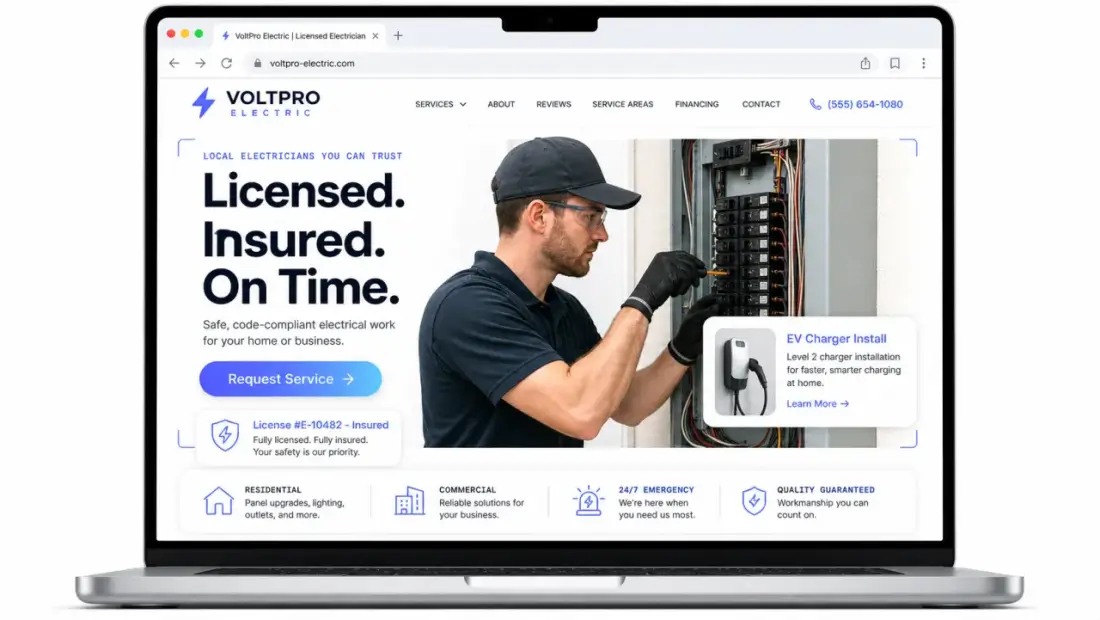
The electrical customer is looking for proof of competence, proof of credentials, and proof you’ll show up. Everything on the site should be doing one of those three things. Here’s the structure that works:

License Number, Insurance, and Year Founded

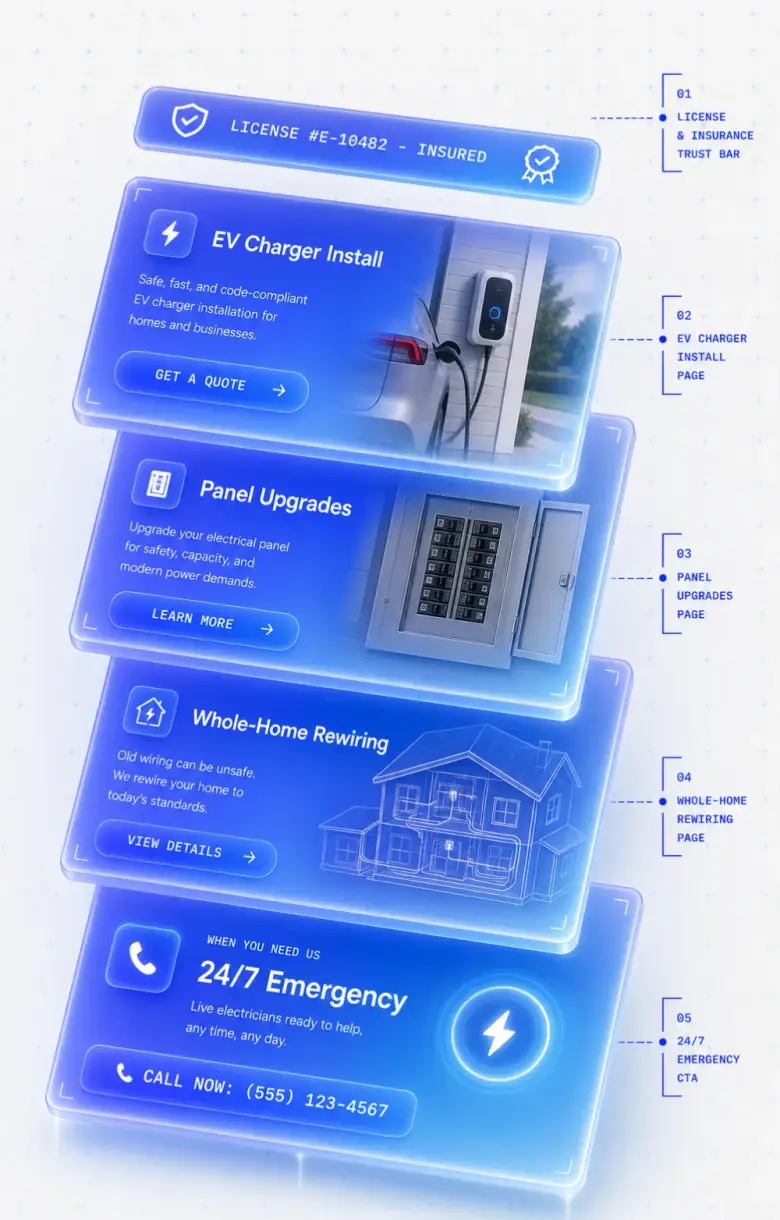
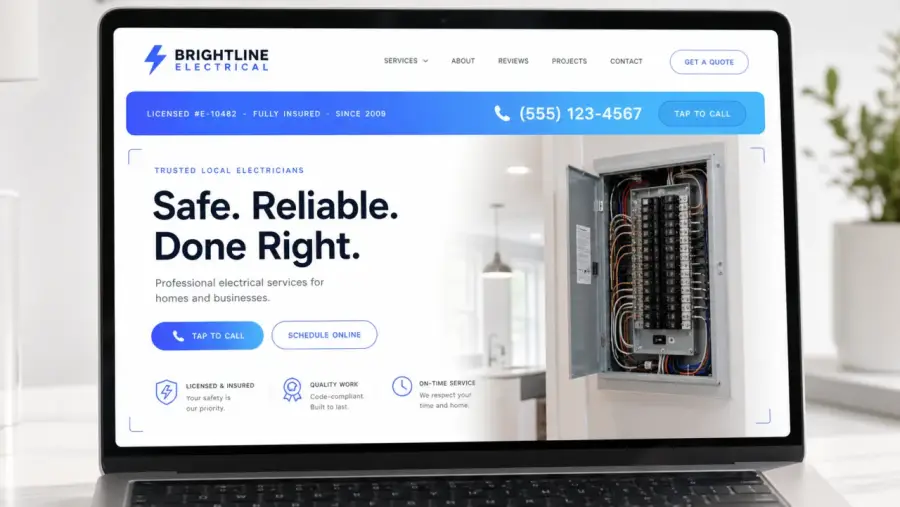
Displayed in the header, footer, on every service page, and inside the contact form. This is the single most-important trust signal for electrical work. A customer who can’t verify your license keeps scrolling.

Service Pages for Every Major Job

Panel upgrades, EV charger install, whole-home rewire, generator install, smart-home wiring, ceiling fan install, troubleshooting, code-compliance work, commercial electrical. Each gets its own page targeting the actual search.

EV Charger Install Page (Dedicated)

This single page is one of the highest-ROI pages an electrician can have right now. Covers Level 2 vs. Level 1, NEMA receptacle vs. hardwired, load calculations, common chargers (Tesla Wall Connector, ChargePoint, JuiceBox, etc.), and federal/utility rebates.

Emergency / Same-Day Service Page

For no-power, sparking, or burning-smell calls. Covers what’s an emergency, your dispatch window, and what to do until you arrive. Highest-intent search there is in the trade.

Project Photos and Case Studies

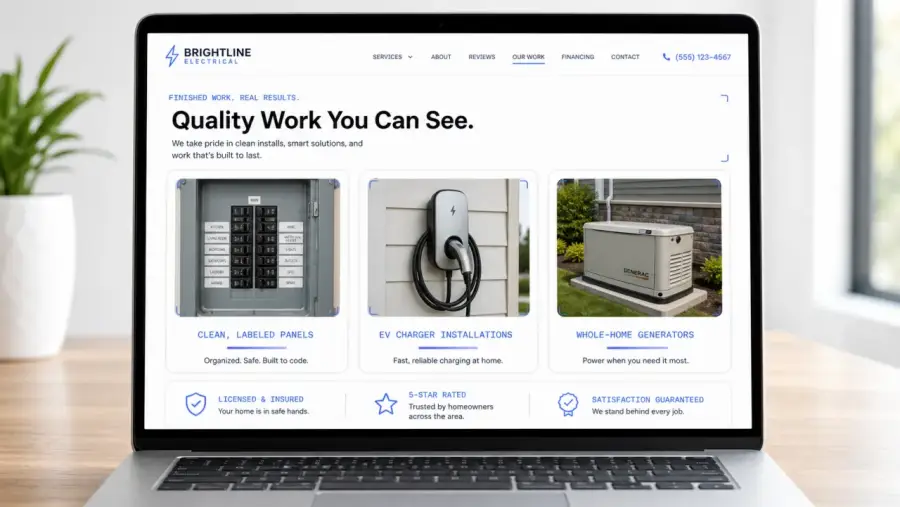
Photos of finished panels, EV chargers, generator installs, and rewires — with brief context (what the customer needed, what you did). Electrical isn’t as visual as landscaping, but seeing a clean install builds confidence.

Click-to-Call Built for Mobile

The phone number is large, tappable, and sticky on mobile. Click-to-call is tracked so you can see which pages drive calls. Emergency electrical customers do not fill out forms; they call.

Service Pages That Help You Rank for Searches That Actually Convert

The electrical trade has both legacy searches (panel upgrades, rewires) and fast-growing modern searches (EV chargers, batteries, smart home). The biggest wins for independent electricians are in the modern category because the search competition is lower — most established electricians haven’t built pages for it yet.

  • EV charger installation [city] / Level 2 charger install. The single highest-growth search in residential electrical. Average install $500 to $2,500 depending on panel work needed. Often turns into a panel-upgrade conversation, which can substantially increase the ticket size.
  • Electrical panel upgrade [city]. $1,500 to $4,500 ticket on average. Customers research heavily — 100 amp vs. 200 amp, brand of panel, permits, inspection. Page should walk through all of it.
  • Whole house rewire [city]. $5,000 to $20,000 jobs. Customers in older homes (pre-1970) needing knob-and-tube or aluminum wiring replacement. Long sales cycle, premium customer.
  • Generator installation [city]. Standby generators ($5K-$15K) and portable transfer-switch installs ($500-$1,500). Region-specific demand — storm-prone areas drive most of the search volume.
  • Electrical troubleshooting / diagnostic. Customers Googling “why is my outlet not working” or “circuit breaker keeps tripping.” Lower ticket but high volume.
  • Outdoor lighting / landscape lighting. Often shared with landscapers; electricians who target this win the higher-end installs.
  • Smart home wiring / smart switch install. Recurring search growth. Pairs well with security and AV cross-selling.
  • Hot tub wiring / pool electrical. Permits-required, code-heavy work that customers can’t DIY. Premium pricing.
  • Commercial electrical [city]. Different audience — property managers, GCs, restaurants. Different trust signals (insurance, bonded, prior commercial work).

Local SEO for Electricians: How We Set It Up

  • Electrician + LocalBusiness schema with license info. Tells Google your license number, service area, hours, and the specific electrical services you offer. Required for proper local-pack ranking.
  • Service-specific title tags. Each page targets a real search. “EV Charger Installer in [City]” instead of “Our Services.”
  • NAP consistency across the web. Identical formatting on the site, GBP, Yelp, BBB, Angi, and the electrical-trade directories.
  • Google Business Profile alignment. Service categories match. License info displayed on both.
  • Reviews integrated. Google reviews surface on the homepage, service pages, and near every call CTA. Trust is everything for electrical.
  • Page speed optimization. Optimized for Core Web Vitals. Emergency electrical customers are mobile-first.
  • Permits and code compliance signals. Pages mention permits where relevant, inspection coordination, and local code compliance. Customers and Google both reward this.

What a New Electrician’s Website Is Actually Worth

Here’s a simple illustration (not a prediction — your results depend on your market, reviews, pricing, and many factors outside the website). Electrical leads have wider variance than most trades — a service-call diagnostic might be $150, a panel upgrade might be $3,500, an EV charger install might be $1,200, a whole-home rewire might be $15,000. So instead of averaging, look at the volume math: if your website brings in one extra panel upgrade per month at $3,000 and two extra EV charger installs per month at $1,500 each, that’s $6,000 a month in incremental revenue. Same site that costs $100 to build and $25/month to maintain. Even modest results easily cover those costs.

The bigger jobs — panel upgrades, rewires, generator installs — almost always come from website research, not referrals. Those customers are calling exactly because they’ve already done their homework on your site.

Why Most Web Designers Overcharge Electricians

Local agencies typically quote several thousand dollars up front plus a monthly retainer in the low-to-mid hundreds for a build of this scope, with specialty trade agencies pricing higher still.

We do it differently. $100 to build, $25 a month for hosting and maintenance, month-to-month, no contract. Free homepage mockup before you pay anything. Custom work — advanced dispatch integrations, custom calculators (load calc, generator sizing) — is quoted separately and only when you ask.

Frequently Asked Questions

Do I need to display my electrical license number on the website?
Yes, and not just because most states require it for advertising — it’s also the single biggest trust signal you have. We display your license number in the header, footer, and on every service page. Customers who can’t verify a license walk away.
How does the site target “EV charger installer near me” searches?
EV charger search is a fast-growing electrical category, and most established electricians haven’t built dedicated pages for it, which tends to mean lower SEO competition for that page. A focused EV charger install page plus proper LocalBusiness schema give Google clean signals about that service — actual rankings still depend on competition, reviews, and factors outside the website.
Can the site explain federal and utility EV charger rebates?
The IRA federal tax credit, state utility rebates, and dealer-specific incentives all get explained on the EV charger page. We update the page when the incentives change. This tends to be one of the strongest-performing content moves in modern electrical sites.
Do you build service pages for older-home work like knob-and-tube and aluminum rewires?
Yes, and they convert exceptionally well because the search terms are specific and high-intent. Anyone Googling “aluminum wiring replacement” or “knob and tube electrician” is a serious, premium-job customer.
Can the site display before/after photos of panel installs?
Yes, and we recommend it. A clean, neatly-labeled panel install photo says more about your work quality than any paragraph of copy. We crop, color-correct, and add brief captions explaining what the customer needed.
How does your site handle commercial vs. residential customers?
If you serve both, we build separate pages with different copy, different proof points (commercial insurance amounts, prior commercial work, vendor-account terms), and different CTAs. Commercial decision-makers want different information than homeowners.
How long until the new site starts producing leads?
Branded searches and Google Business Profile clicks can drive direct visits from launch day. Organic search rankings on competitive electrical terms take months to build and depend on factors outside the website itself.

Get a Free Homepage Mockup

We’ll design a free homepage mockup for your electrical business before you pay.

Get My Free Homepage Mockup See Pricing
$100
Starting build fee
$25
Monthly hosting & maintenance
1–2
Weeks to launch

Let’s Build Your Electrical Website

Send the basics and we’ll be in touch with next steps for your free homepage mockup.

Tell Us About Your Business