Why It Matters

Most Landscapers Lose Jobs Before the Phone Even Rings

Here is what actually happens when a homeowner needs a new patio, a sod install, or someone to keep the yard maintained: they pull out their phone and Google something like “landscaping near me,” “sod installation [their city],” or “landscaper for retaining wall.” Then they click the first three or four results that look professional, send an estimate request, and hire whichever company gets back to them first. The decision is usually made before you ever know they exist.

About 97% of consumers research a local business online before making contact. That number is from BrightLocal’s annual consumer-behavior research, and it has held steady for years. If your landscaping company doesn’t come up in those Google results — or it does come up but the site looks like it was built in 2008 — you lose the lead to whichever competitor took the time to build a real website. Word-of-mouth still works. Yard signs still work. Truck wraps still work. But all of those have a ceiling, and they all eventually point back to one question: can the customer find you online when they actually need you?

Picture the highest-value lead you can realistically close. A new homeowner just moved into the neighborhood. They don’t know a single landscaper in the area. They want a full yard redesign — grading, sod, irrigation, beds, a small retaining wall, maybe lights. That is a $5,000 to $15,000 job. They will not call a Facebook page. They will not call a company that ranks below the fold. They will call the landscaper whose website made them feel like the work was already half-bought.

What Happens When Your Landscaping Business Has No Real Website

  • You disappear from Google. Google ranks websites — not Facebook pages, not Instagram grids, not Nextdoor profiles. A Google Business Profile alone is not enough to compete in any reasonably populated metro. To show up in the local map pack and the organic results below it, you need a website with service pages, location signals, and a steady NAP (name, address, phone) record that Google can verify.
  • You look smaller than you are. Customers who are about to spend $5,000 to $20,000 on hardscape, sod, or a full landscape design want to see proof. If the only thing they can find is a Facebook page with five phone photos and no service list, they assume your work matches the presentation — and they keep scrolling to a landscaper whose site looks like a business they want money on the line with.
  • Your best work has nowhere to live. Landscaping is one of the most visual trades there is. Before-and-after galleries, project photos organized by service type, and seasonal portfolios are exactly what turn a curious visitor into an estimate request. A Facebook timeline buries your best work after about three weeks. A website keeps it organized and searchable forever.
  • You miss every after-hours lead. Most homeowners do not call landscapers from their desk at 10am. They research in the evening, on the couch, after dinner. If there is no website to land on at 9pm, no contact form, and no clear price-range cue, the lead either dies or goes to whichever competitor was reachable in that moment. A simple estimate form captures those leads while you sleep.
  • You cannot win commercial contracts. Property management companies, HOAs, and commercial property owners search online for landscapers and will not even put you on a bid list without a real website that shows insurance, service scope, and prior commercial work. A polished site moves you from “guy with a truck” to “vendor we will send a contract to.”

What Customers Actually Want to See on a Landscaping Website

Most landscaping websites get built backwards. A web designer who has never sold a $7,000 patio will pad the homepage with stock photos and generic copy, and call it done. Customers scroll right past it. The pages that close real jobs are built around the actual decision the homeowner is making: is this company good, is this company local, and is this company the easiest one to contact right now? Every section of your site should be answering one of those three questions.

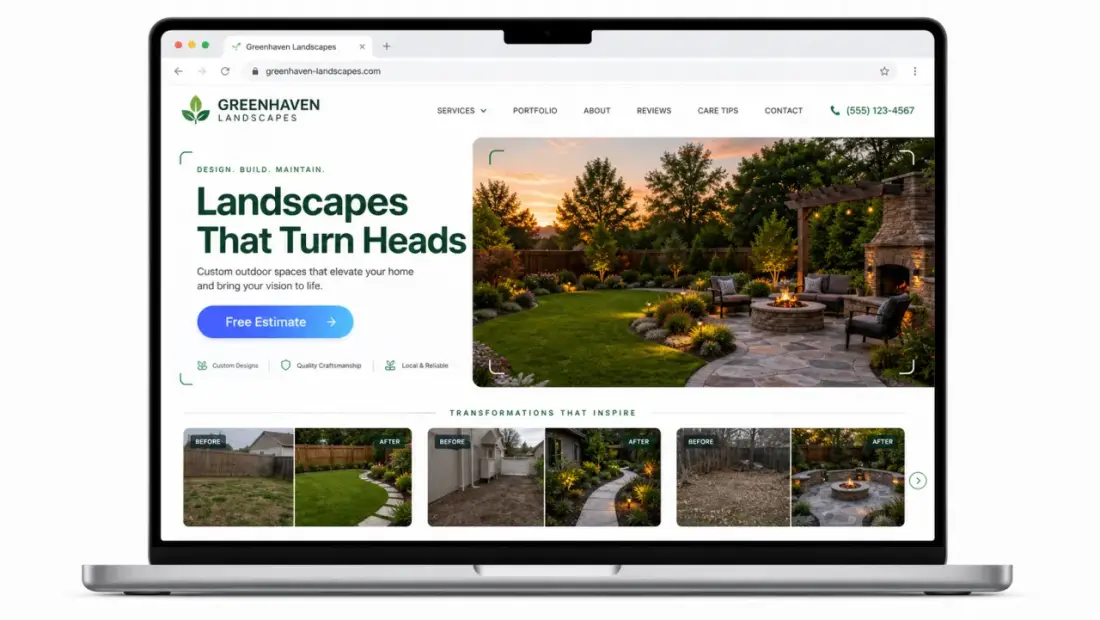
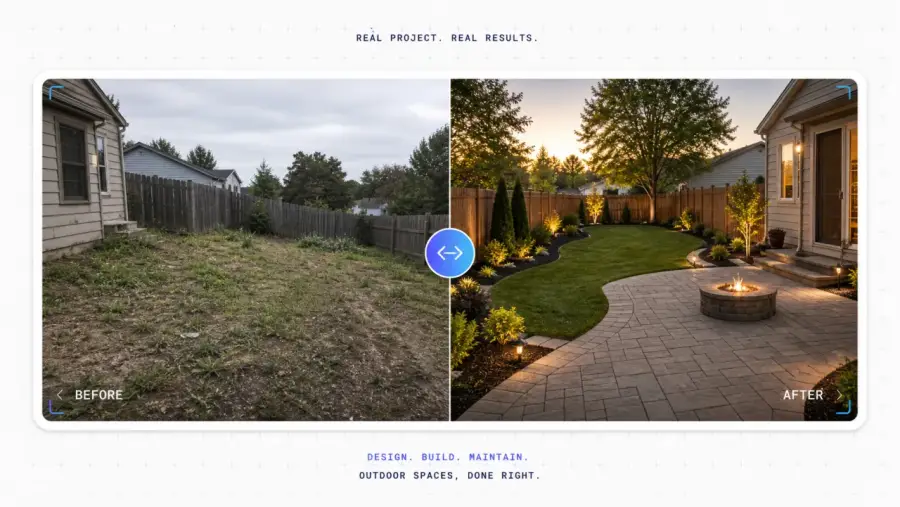
Before-and-After Project Gallery

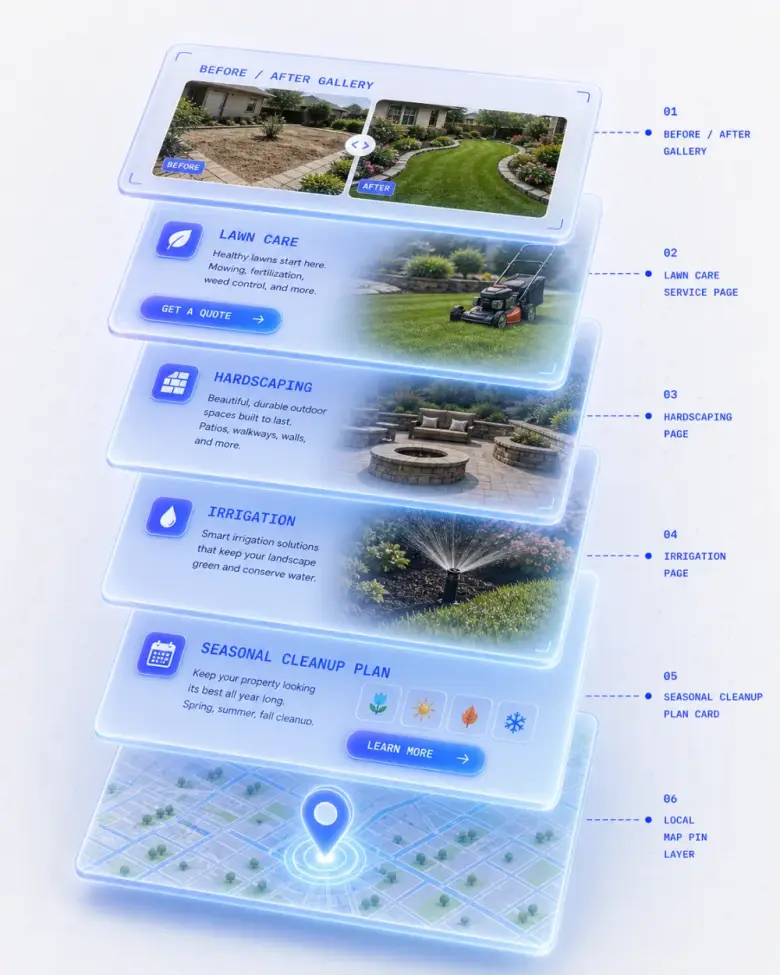
Organized by service type — patios, hardscape, sod installs, garden design, full redesigns, cleanups. Real photos of completed work in your service area. Nothing closes a landscaping job faster than letting your finished work do the selling.

Service Pages, Not Just a Service List

One dedicated page per service: lawn care, hardscape, irrigation, mulch, sod, fall cleanup, snow removal, lighting. Each page targets a real Google search someone in your market is making this week. Each one explains what is included, what it costs in general terms, and how to request an estimate.

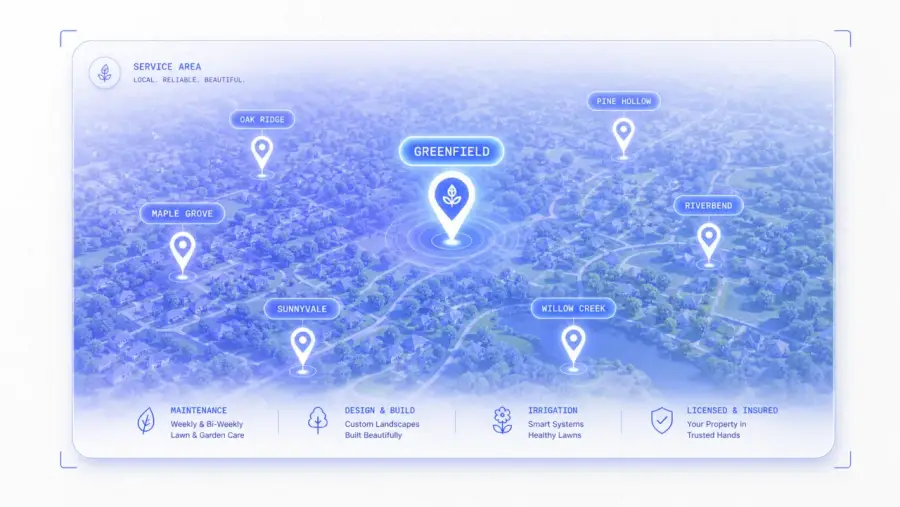
Service-Area Pages for Every Town You Cover

One page per neighborhood, suburb, or zip code you actually serve. This is what makes your site rank for searches like “landscaping in [town]” — the exact searches your highest-intent customers run. We map these to your real service radius, not arbitrary boundaries.

Click-to-Call Built for Mobile

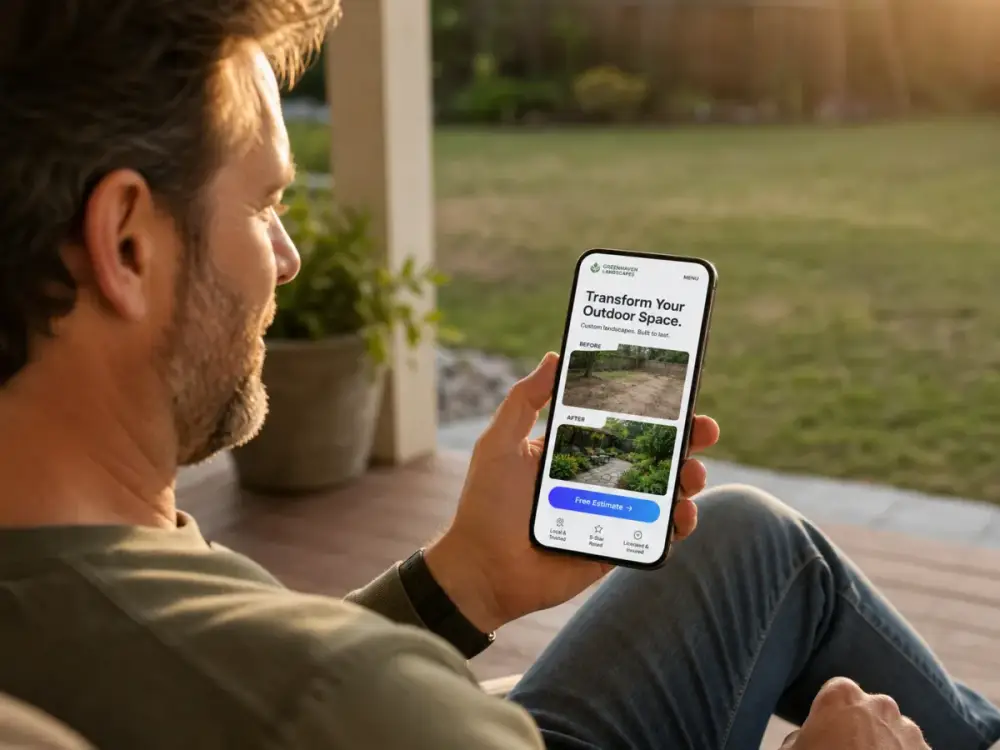
Sixty to seventy percent of your visitors are on a phone. One tap on your phone number opens their dialer. No copy-paste, no scroll-hunting. Sticky call buttons on long pages. Buttons sized large enough to hit without zooming.

Estimate Request Form That Actually Qualifies

A short form that asks the right questions up front — address, service type, budget range, timeline — so your inbox fills with leads you can quote on, not leads you have to chase for basic information. Forms go to your email, your phone, or both.

Reviews and Trust Signals Prominent

Your Google reviews surfaced on the homepage, on every service page, and near every CTA. Logos of HOAs, builders, or commercial accounts you work with. Years in business, license info when applicable, insurance disclosures. Trust is the single biggest driver of whether someone calls or scrolls.

Service Pages That Help You Rank for Searches That Actually Convert

A landscaping homepage cannot rank for everything. Google ranks pages, not entire websites — so the trick is building one focused page per high-intent search you want to compete for. We use trade-specific search data to map your services to the pages most likely to draw qualified search traffic. A few examples of pages we typically build for a landscaper:

  • Lawn care service [city]. The bread-and-butter recurring-revenue page. Targets weekly mow, fertilization, aeration, weed control, and seasonal cleanups. Mid-volume, mid-intent — lots of clicks, lots of forms.
  • Patio installation [city] / paver patio contractor [city]. Lower volume but each lead is worth $4,000 to $15,000. Page leads with project gallery and walks through material options.
  • Sod installation [city]. Often hyper-seasonal and hyper-local. Covers sod types you carry, install process, watering guarantees if any, and lawn-prep requirements.
  • Retaining wall contractor [city]. one of the strongest-performing pages because the search is overwhelmingly bottom-of-funnel — people searching this term are about to hire someone.
  • Landscape design [city]. For the homeowners doing full redesigns. Higher-ticket, longer sales cycle, but each lead can be a 5-figure project.
  • Fall cleanup / spring cleanup. Time-bound seasonal pages that get crushed with traffic in October and March. Recurring revenue accelerators.
  • Mulch delivery and install. Useful in spring, often a relationship-starter for larger seasonal work later.
  • Commercial landscaping / HOA landscaping [city]. Different visitor, different copy, different proof points. Worth its own page if you bid contracts.

You do not need all of these on launch. We start with the four or five highest-revenue service pages and add the rest as the site earns traction.

Local SEO for Landscapers: How We Set It Up

Local SEO is what makes a landscaping website show up when someone two miles from your shop searches “landscaper near me.” It is not a separate service we tack on; it is part of how we build every page on the site. Here is roughly what is configured by the time your site launches:

  • Title tags and meta descriptions written for the search. Each service page and each service-area page has a unique title aimed at the term it should rank for — not the default WordPress placeholder.
  • Local-business schema markup. Structured data tells Google your business name, address, phone, hours, service area, and service list in a machine-readable format. This is what powers the rich results you see in local search.
  • NAP consistency. Your name, address, and phone are formatted identically on the site, your Google Business Profile, and the major directories. Inconsistent NAP is one of the most common reasons a landscaper’s rankings stall.
  • Google Business Profile alignment. Your site links to your GBP, your GBP links to your site, and the service categories match. Reviews you collect on GBP can be surfaced directly on the site.
  • Internal linking structure. The homepage links to service pages, service pages link to the relevant service-area pages, service-area pages link to the project gallery. This is how Google understands the topical depth of your site.
  • Image alt text and file names. Every project photo includes alt text that describes the work — not “IMG_2873.jpg.” This is both an accessibility win and a Google-image-search win.
  • Page speed and mobile readiness. Landscapers’ sites lose more rankings to slow mobile load times than almost any other cause we see. We test every site against Google’s Core Web Vitals before launch and prioritize fast mobile load.

What a New Landscaping Website Is Actually Worth

Here’s a simple illustration (not a prediction — your results depend on your market, reviews, pricing, and many factors outside the website). Run the math the way a contractor would. Say your average closed job is $1,200 — somewhere between a lawn-care season and a small hardscape add-on. Now say your website brings in only two extra closed jobs per month from people who would not have found you otherwise. That is $2,400 a month, or $28,800 a year. A website that costs $100 to build and $25 a month to maintain easily pays for itself if even a fraction of that holds. Everything beyond that is margin.

The bigger jobs — the $6,000 patio, the $9,000 sod redo, the $14,000 full landscape design — are typically the ones that come from a website rather than referrals, because those are the customers who do the most research before calling. They are searching specifically because they are about to spend real money. They want to be sure they are calling the right company.

Why Most Web Designers Overcharge Landscapers

Local agencies typically quote several thousand dollars up front plus a monthly retainer in the low-to-mid hundreds for a build of this scope, with specialty trade agencies pricing higher still.

We do it differently. The build starts at $100. Hosting, security, backups, and software updates are $25 a month, month-to-month, no contract. You see a free homepage mockup first — before you pay anything — so you know what you are buying. If you ever decide to leave, we provide a reasonable export of your files where technically available. Custom work outside the standard build is quoted separately and only when you ask for it.

Frequently Asked Questions

How long does it take to build a landscaping website?
Most landscaping sites launch in 1 to 2 weeks after we receive your basic business details (services, service area, contact info, photos). The free homepage mockup comes back as soon as we can put it together, and the full build follows once you approve the direction.
I already have a Google Business Profile and a Facebook page. Do I really need a website?
A Google Business Profile helps you show up in the local map pack, but the listings ranked highest on GBP almost always have a website attached — that is how Google verifies the business is real and serves the area. Facebook reaches people who already know about you. A website is what gets you in front of homeowners who don’t know you exist yet.
Will my landscaping website actually rank on Google?
Every site we build ships with the SEO foundation in place: clean URL structure, title tags written for real searches, schema markup, NAP consistency, internal linking, and fast mobile load times. Organic search rankings on competitive landscaping terms take months to build, and the highest-intent service pages (retaining walls, sod, patios) tend to face less competition than the head term “landscaping.”
Can you build service-area pages for every town I cover?
Yes, and we recommend it. One page per town or zip you actually serve is one of the highest-impact SEO moves a local landscaper can make. We do not build “doorway” pages with copy that is just the town name swapped in — each page covers the specific neighborhoods, soil types, common projects, and reviews relevant to that area.
Do you write the copy for my landscaping website?
We write the copy as part of the build using the details you send (services, service area, what makes you different, sample projects). You approve every page before launch and can make changes any time after. Custom copy revisions beyond the initial round are quoted separately if they get extensive.
What if I want to add a new service or seasonal promotion later?
Adding a page, updating a service, or running a seasonal landing page (spring cleanup, fall cleanup, snow removal) is included as part of the $25/month plan within reasonable limits. Large new sections or full redesigns are quoted separately, but most landscapers never need them — small adjustments and seasonal updates cover almost everything.
Do I need to provide my own photos?
Your own project photos are best — nothing sells landscaping like real before-and-after shots of work in your actual service area. If you don’t have many on hand yet, we can launch with high-quality stock images that match your service mix and swap in real project photos as you collect them. Phone photos are fine; we crop and color-correct them on the build.

Get a Free Homepage Mockup

We’ll design a free homepage mockup for your landscaping business before you pay.

Get My Free Homepage Mockup See Pricing

See a Live Sample

View a sample website built for this kind of service business.

View Sample Landscaping & Mulch Site →
$100
Starting build fee
$25
Monthly hosting & maintenance
1–2
Weeks to launch

Let’s Build Your Landscaping Website

Send the basics and we’ll be in touch with next steps for your free homepage mockup.

Tell Us About Your Business