Local Market

Dallas-Fort Worth Is One of the Most Competitive Local-Search Markets in America

The DFW Metroplex is the fourth-largest metro in the United States. Roughly 7.7 million people live across Dallas, Tarrant, Collin, and Denton counties, and another 400,000 move in every two years. That growth is good for any service business — new homeowners and new commercial spaces every day — but it makes local SEO harder than almost anywhere else. The DFW market is saturated with HVAC companies, plumbers, roofers, landscapers, foundation specialists, and pool service operators all bidding for the same Google rankings.

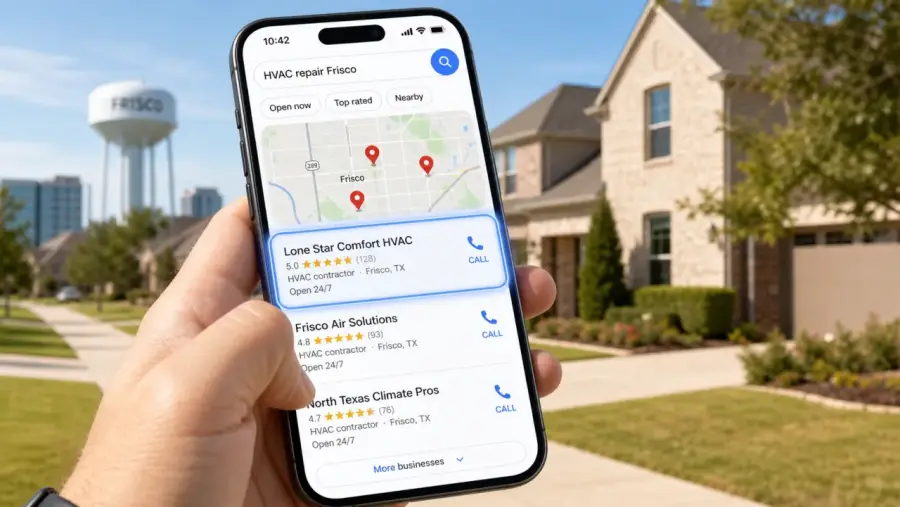
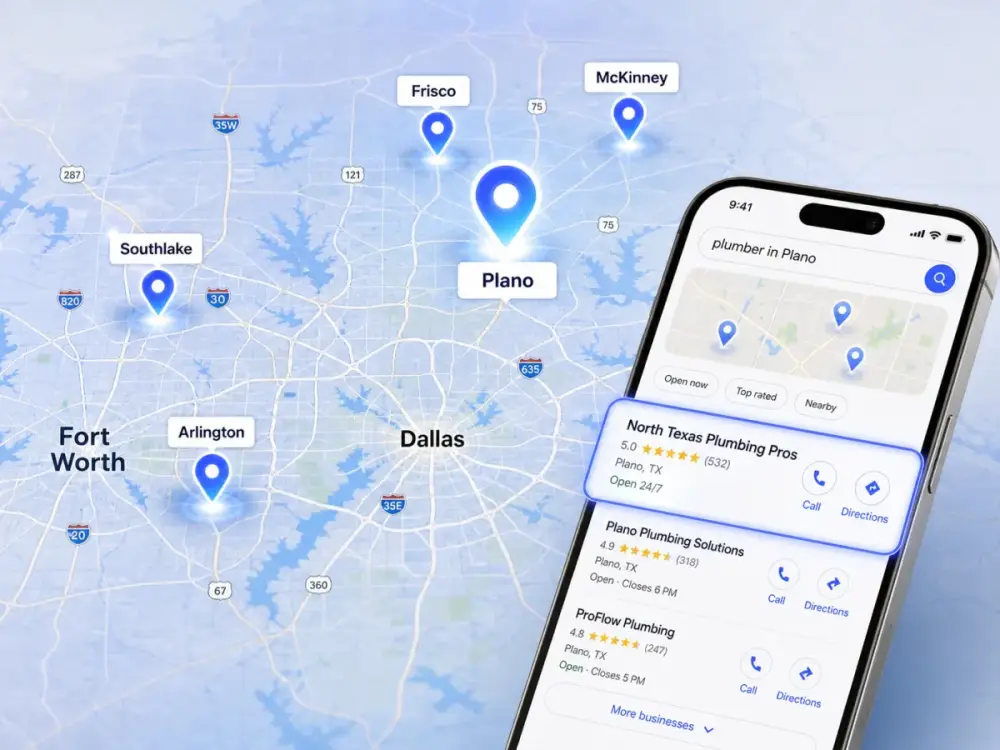
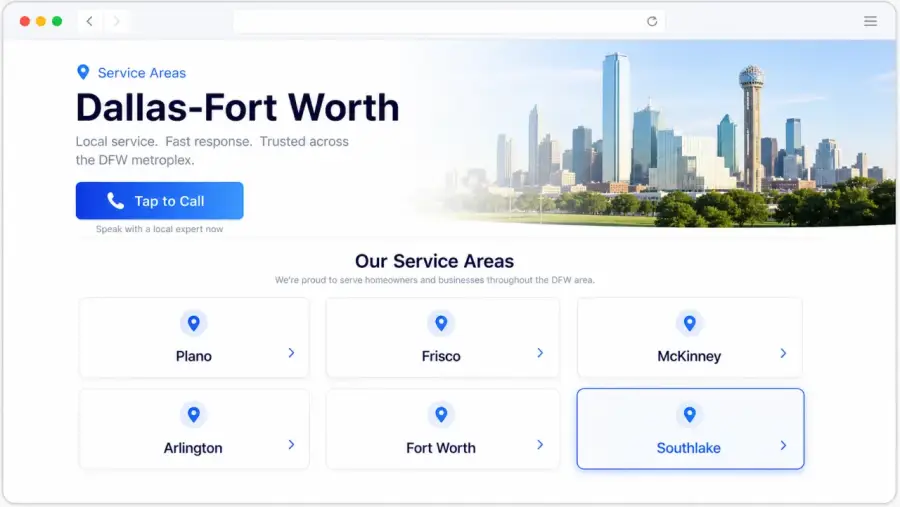
The way you win in DFW is by going granular. You don’t rank for “plumber Dallas” against national franchises and 200 local competitors. You rank for “plumber in Plano,” “HVAC repair Frisco,” “roof replacement McKinney,” or “pool service Southlake.” Every site we ship for a DFW small business has a service-area page for each town and zip the company actually serves, with copy that mentions real neighborhoods, real soil conditions (the clay that causes foundation issues), and real weather patterns (the hailstorms that drive 80% of Dallas roofing demand).

DFW is also one of the most mobile-search-heavy markets in the country because of how spread out the metroplex is. A homeowner in Mesquite searching for a plumber doesn’t want a company headquartered in Plano — they want someone within 15 minutes of their house. Local SEO is what tells Google which neighborhoods you actually serve. Get that right and your site shows up. Get it wrong and you’re invisible.

What Makes Dallas Web Design Different

  • Hyper-local service area pages. One page each for Dallas proper plus the major suburbs: Plano, Frisco, McKinney, Allen, Richardson, Garland, Mesquite, Irving, Grand Prairie, Arlington, Fort Worth, Bedford, Hurst, Euless, Grapevine, Southlake, Coppell, Carrollton, Lewisville, Flower Mound, Denton, and beyond. Each one written around the neighborhoods and street patterns that actually exist there.
  • Trade-specific local pages. “Foundation repair in Plano” ranks separately from “HVAC in Plano” ranks separately from “plumbing in Plano.” Each gets its own page on a multi-trade site, or its own variant on a single-trade site.
  • Weather-driven content. Hailstorms drive a huge percentage of DFW roofing and exterior repair demand. We pre-build templates for storm pages so they can launch as soon as hail event in your zip codes hits.
  • Foundation copy on home-service sites. Dallas has some of the most expansive clay soil in the country, which means foundation issues are constant. Any plumber, HVAC contractor, or general repair company benefits from at least one page that mentions slab piers, leveling, and the soil reality.
  • Commercial-buildout pages where applicable. DFW’s commercial construction boom is non-stop. If you do commercial work in any trade, a dedicated commercial page can capture a meaningful slice of that pipeline.

Service Areas Across DFW

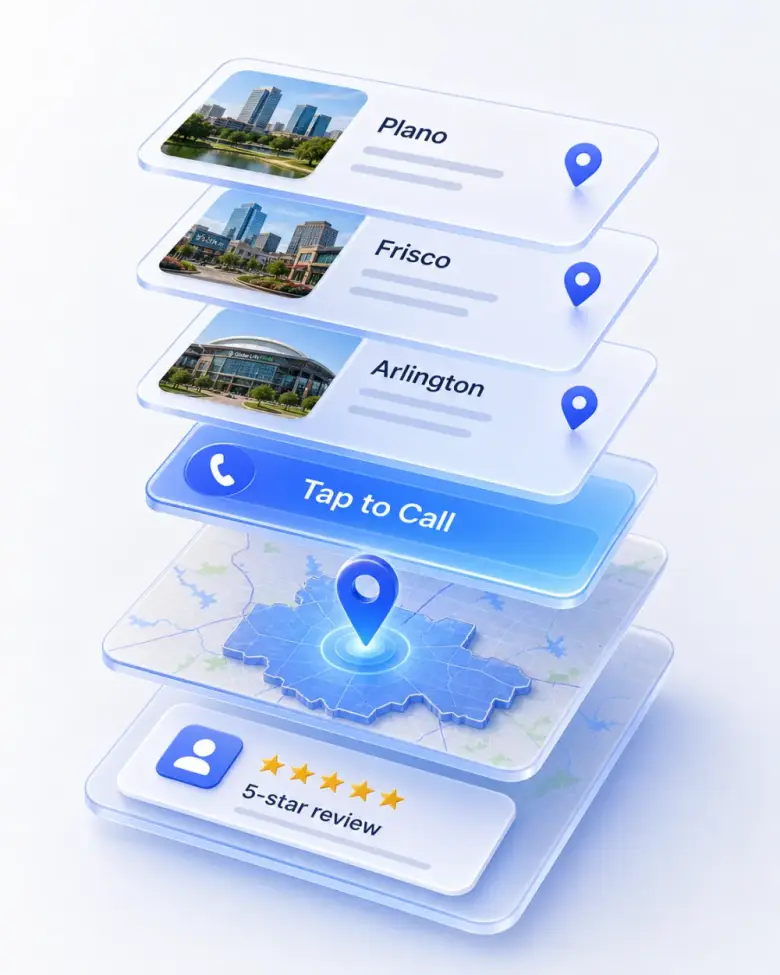
We build hyperlocal service-area pages for every suburb you actually serve. Below is a rough map of how DFW typically gets segmented for service-business SEO purposes — we’ll align this with the radius you actually drive:

Dallas County

Dallas, Mesquite, Garland, Irving, Grand Prairie, Richardson, Carrollton, Cedar Hill, DeSoto, Duncanville, Lancaster, Farmers Branch, Coppell, Highland Park, University Park, Rowlett.

Tarrant County

Fort Worth, Arlington, Bedford, Hurst, Euless, Grapevine, Southlake, Keller, North Richland Hills, Mansfield, Burleson, Crowley, Saginaw, Watauga, Colleyville.

Collin County

Plano, Frisco, McKinney, Allen, Wylie, Murphy, Prosper, Celina, Anna, Princeton, Melissa, Fairview, Lucas, Parker, Lavon.

Denton County

Denton, Lewisville, Flower Mound, The Colony, Little Elm, Highland Village, Argyle, Justin, Roanoke, Trophy Club, Northlake, Corinth, Lake Dallas.

Trades That Win Hardest in Dallas-Fort Worth

Every service trade can rank in DFW with the right site, but a few categories have outsized demand because of the local climate, soil, growth rate, and economy:

  • HVAC. Triple-digit summers, mild but unpredictable winters, and constant new construction make HVAC one of the deepest service markets in DFW. Maintenance plans alone are a six-figure recurring business in this metro.
  • Roofing. DFW averages 3-4 significant hail events per year. Storm chasing is constant; legitimate local roofers with strong websites tend to capture a meaningful share of the post-storm insurance-claim pipeline.
  • Plumbing. Old galvanized and cast-iron plumbing in older Oak Cliff, East Dallas, and Fort Worth neighborhoods drives steady repipe demand. New construction in Frisco and McKinney drives install volume.
  • Foundation repair. Clay soil + extreme drought-rain cycles = constant foundation movement. Specialty trade with high tickets ($4K-$15K+).
  • Pool service. Pools are common in middle-class DFW homes. Weekly service, equipment repair, and resurfacing all drive recurring revenue.
  • Landscaping. Heat-tolerant lawns, irrigation, and hardscape all in heavy demand. Premium landscape design in Highland Park, Plano, and Southlake commands high tickets.
  • Tree service. Wind, ice storms, and oak wilt all drive removal and trimming demand year-round.
  • Pest control. Texas heat brings termites, ants, scorpions, and roaches. Recurring quarterly plans are the gold standard.
  • Concrete and masonry. Driveway replacement, foundation slab work, and stamped patio installs are all robust DFW categories.

Local SEO We Set Up for Dallas Businesses

  • Service-area pages for every town and zip you cover. Each page written around real local detail — neighborhoods, school zones, road patterns, climate considerations — not just “[trade] in [town].”
  • DFW-specific LocalBusiness schema. Structured data identifies your service area, hours, and offered services in a format Google can parse for the local pack.
  • NAP consistency across DFW directories. Identical name/address/phone on your site, Google Business Profile, Yelp, BBB, Nextdoor business pages, Angi, and the trade directories most relevant to your trade.
  • Google Business Profile alignment. Your GBP service categories, service areas, and primary attributes match what’s on the site. Reviews surface across both.
  • Storm-event content templates. Pre-built page templates for hailstorm, ice-storm, and tornado-related service spikes — deployable as soon as event hits.
  • Mobile-first speed. Optimized for fast mobile load and tested against Core Web Vitals before launch.
  • Internal linking for topical authority. Each service page links to relevant service-area pages, building the topical structure Google uses to rank local businesses.

What a Dallas Website Is Actually Worth

Here’s a simple illustration (not a prediction — your results depend on your market, reviews, pricing, and many factors outside the website). The DFW market is one of the largest in the country, so for a service business that ranks well across a few suburbs, the volume can add up quickly. Run the numbers for your trade: if a website brings in 10 extra qualified leads per week at a $400 average closed ticket and a 30% close rate, that’s $4,800/week or $250,000+/year in incremental revenue from leads that wouldn’t have found you otherwise. Even modest results easily cover the $100 build and $25/month maintenance.

For premium trades (foundation repair, full HVAC system replacement, full roof replacement after a hail event, custom pool builds), even one extra closed job per month from website traffic can produce $5,000-$30,000 in incremental annual revenue.

Why Most Web Designers Overcharge Dallas Businesses

Local agencies typically quote several thousand dollars up front plus a monthly retainer in the low-to-mid hundreds for a build of this scope, with specialty trade agencies pricing higher still.

We do it differently. $100 build, $25/month hosting and maintenance, month-to-month, no contract. Free homepage mockup first. Storm-event content, custom dispatch integrations, and trade-specific calculators are quoted separately and only when you ask.

Frequently Asked Questions

How many DFW suburbs should my site cover?
As many as you actually drive to. We typically launch with service-area pages for the 8-12 highest-revenue suburbs in your radius and add more as the site earns traction. Building 30 doorway pages with copy that’s just the town name swapped in is the fastest way to get penalized by Google — we build pages with real local detail or we don’t build them at all.
How does the site target [trade] near me searches in Plano, Frisco, or McKinney?
That’s where the wins are. Suburb-specific searches are generally less competitive than “[trade] Dallas” because the competition is much narrower. A focused service-area page with real local detail plus proper LocalBusiness schema give Google clean signals about that service area — actual rankings still depend on competition, reviews, and factors outside the website.
What if a hailstorm hits my service area? Can the site capture the spike?
We keep storm-content templates ready to deploy as soon as hail event hits. Storm SEO rewards speed; the first locally-relevant page published after an event captures the largest share of the search spike that follows.
Can the site display Texas state license and contractor info?
Texas plumbing licenses, HVAC ACR licenses, electrician licenses, irrigator licenses, and Texas Real Estate Commission contractor info all get displayed prominently where required by state advertising rules.
Will the site help me win commercial work in DFW?
We build a separate commercial section with different copy, photos, and proof points (insurance amounts, prior commercial work, vendor terms). DFW’s commercial construction boom is one of the strongest in the country and worth its own dedicated page.
How long until I see leads from the new Dallas website?
Branded searches and Google Business Profile clicks can drive direct visits as soon as the site is live. Organic search rankings on competitive terms take time to build and depend on factors outside the website itself.
Do you understand the DFW market?
The site structure, suburb mapping, climate-driven content, and storm-event templates we use are all built around how the DFW market actually buys local services. We’re not transplanting a Boston playbook to Dallas.

Get a Free Dallas Mockup

We’ll design a free homepage mockup for your local business before you pay.

Get My Free Homepage Mockup See Pricing
$100
Starting build fee
$25
Monthly hosting & maintenance
1–2
Weeks to launch

Let’s Build Your Dallas Website

Send the basics and we’ll be in touch with next steps for your free homepage mockup.

Tell Us About Your Business