Why It Matters

A Broken Garage Door Is a Whoever-Answers-First Hire

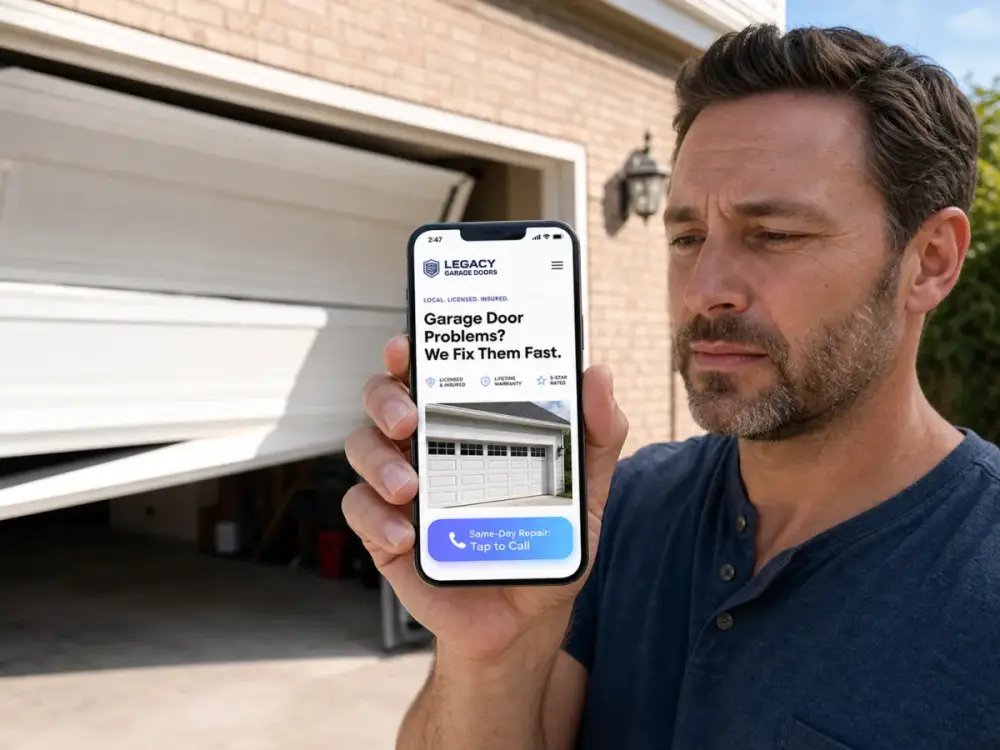
The customer with a garage door stuck halfway down at 7am isn’t comparison shopping. They’re late for work, the car is trapped inside, and they Google “garage door repair near me” from the driveway. The first company that loads quickly on their phone, has a tappable phone number above the fold, and looks legitimate gets the call. Everyone else gets ignored. There is no other trade where speed of response and quality of mobile site map more directly to revenue.

Garage doors are also one of the most volume-driven categories in home services. The average homeowner’s garage door springs last 10,000 cycles — about 7-10 years for typical use, less for households opening it multiple times a day. The opener motor lifespan is 10-15 years. Panels get dented by basketballs, bikes, and bumpers. Cables snap. Rollers wear out. Every one of those failures triggers a Google search that becomes a service call within hours.

And then there’s the new-door market. A full garage door replacement runs $1,200 to $4,000 for residential, more for double doors or premium materials. These customers research extensively before calling. They want to see styles, materials, brands, and finished installs in homes that look like theirs. Your website is the showroom — no website, no showroom, no premium installs.

What Happens When Your Garage Door Business Has No Real Website

  • You lose every emergency call. Garage door customers are mobile, urgent, and impatient. A slow website or missing site = a competitor’s service call.
  • You can’t compete with the franchises. The major national garage door franchises spend serious money on websites and Google ads. They rank prominently in the local pack in most metros. Independent operators with no website are invisible by comparison.
  • You miss the new-door market. Customers buying a $3,000 new garage door research for 2-4 weeks. Without project photos and a clean style catalog, you don’t exist in that decision.
  • Commercial garage door work goes elsewhere. Property managers, warehouses, and businesses with rolling doors hire on paper. A website with commercial experience and insurance info is the entry ticket.
  • You can’t justify pricing transparency. Customers who don’t see your typical service-call rate before they call are the ones who price-shop competitors after they arrive. Published ranges qualify leads better.

What Customers Actually Want to See on a Garage Door Website

The garage door customer is in one of two modes: emergency (something is broken right now) or shopping (new door or opener). The site has to serve both clearly without confusing either. Here’s the structure that works:

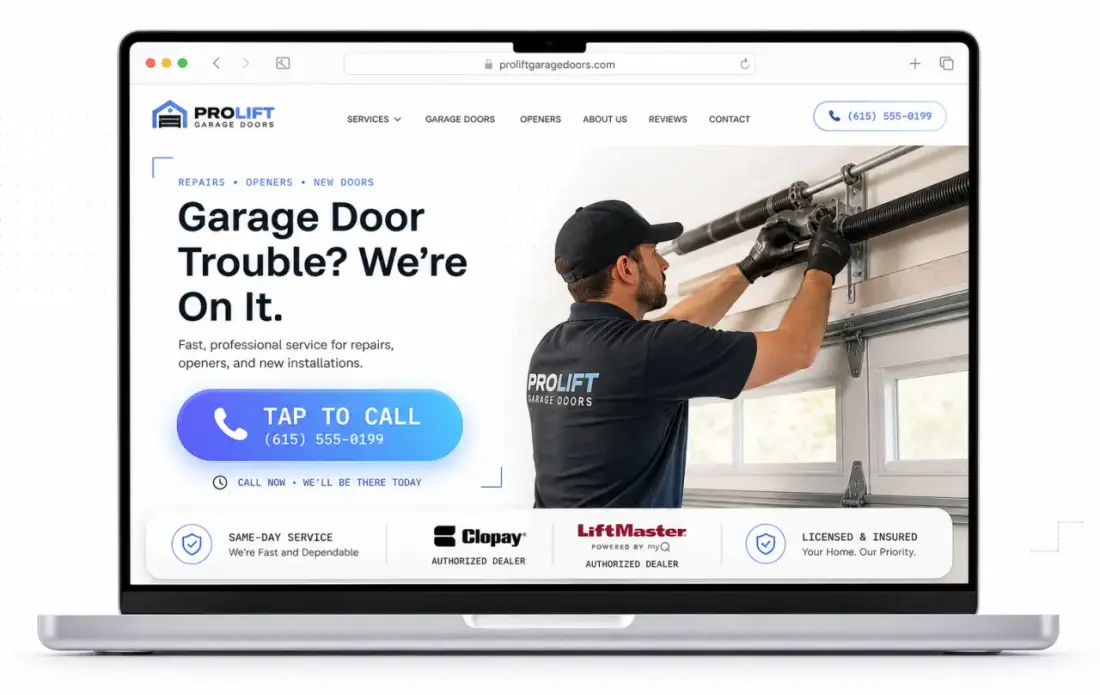
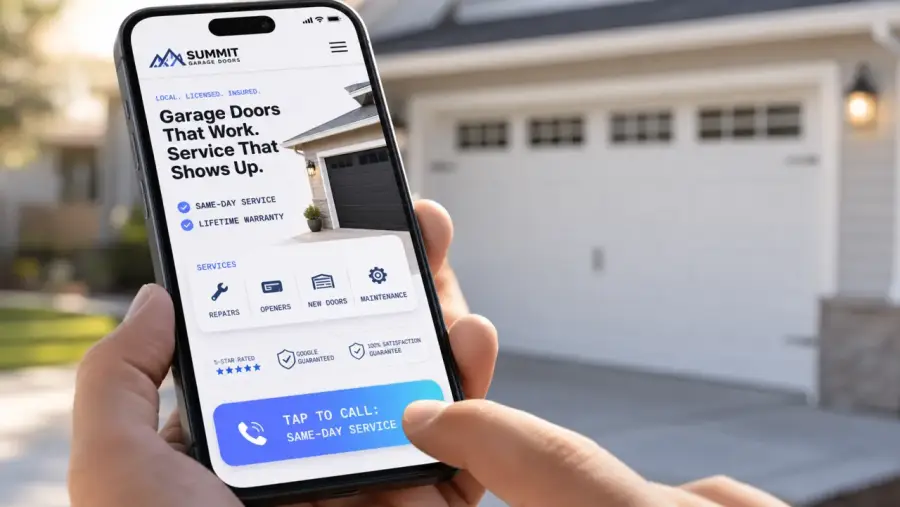
Massive, Tappable Phone Number

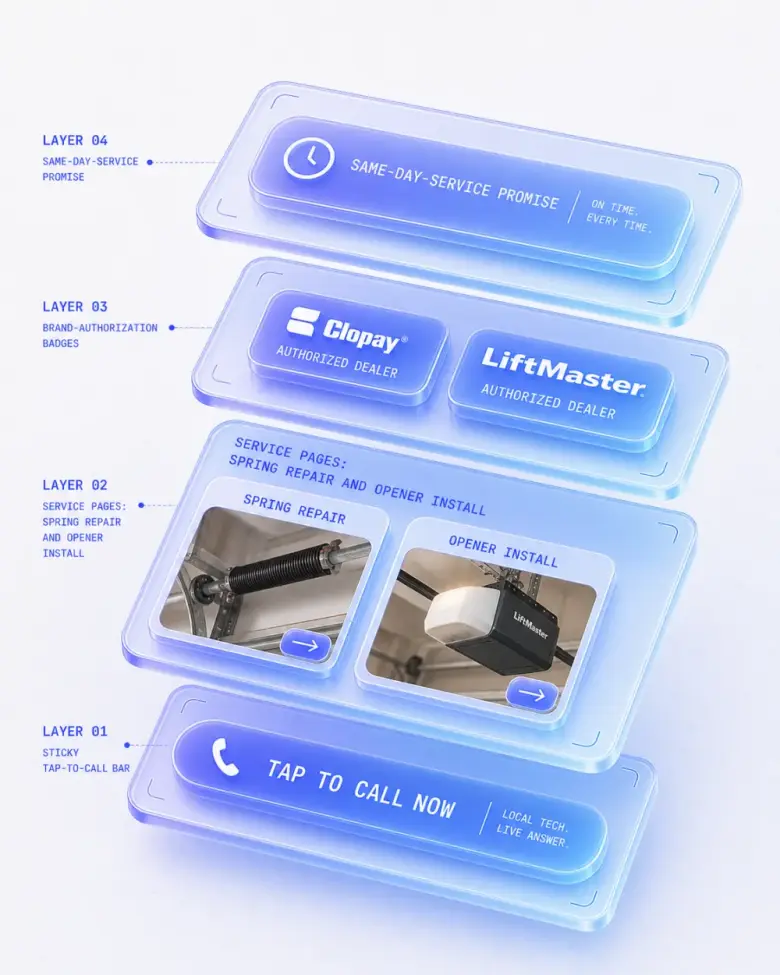
In the header, in the hero, sticky on mobile scroll, and at the bottom of every service page. One tap to call. Same-day service promise displayed prominently. This is the most-clicked element on any garage door site.

Same-Day Service Page

Dedicated “same-day repair” or “emergency garage door repair” page targeting the highest-intent search there is. Covers your dispatch window, after-hours rates, and what counts as urgent.

Service Pages for Every Major Job

Spring repair, opener install, opener repair, cable repair, panel replacement, new door installation, roller replacement, off-track repair, weather seal, smart-door integration. Each gets its own page.

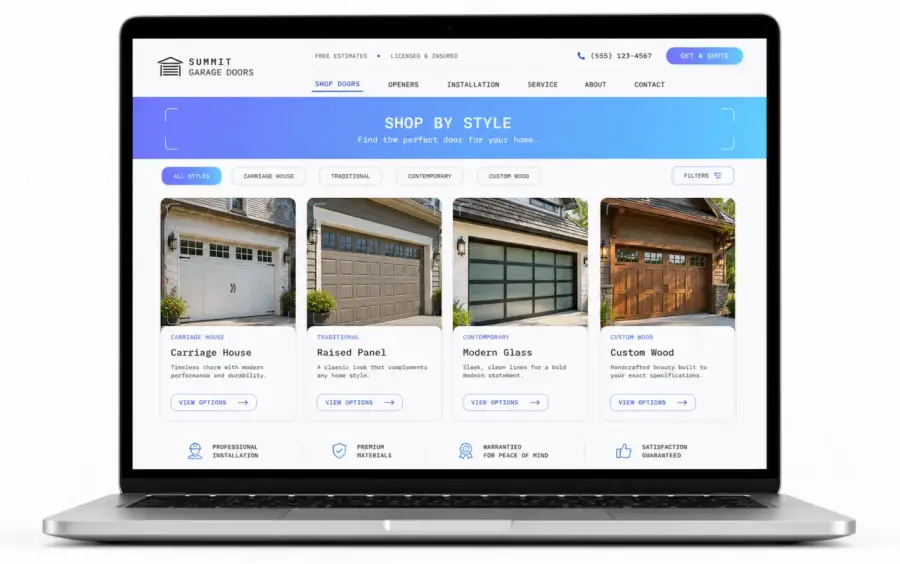
New Door Catalog / Style Gallery

If you sell new doors, a page or section showing styles (carriage house, traditional raised panel, contemporary, custom wood, glass garage doors) with brand and material options (steel, wood, fiberglass, aluminum). Customers shopping new doors research extensively.

Brand Authorizations and Certifications

Authorized dealer status for Clopay, Amarr, Haas, C.H.I. Overhead Doors, LiftMaster, Genie, Chamberlain. Manufacturer warranties displayed. IDEA certification if you have it.

Service-Area Pages

One page per town or zip with same-day-service promise and any local detail (e.g., common door issues in older neighborhoods with original 1980s doors).

Service Pages That Help You Rank for Searches That Actually Convert

  • Garage door repair [city]. Highest-volume search. Average ticket $150-$500. Page should cover what you typically repair and your dispatch window.
  • Garage door spring repair [city]. The single most-common garage door failure. Customers actively Googling because their door won’t open. Average $200-$400.
  • Garage door opener repair / opener installation [city]. Mid-volume, mid-ticket. New opener install $300-$700.
  • New garage door installation [city]. Premium category. $1,200-$4,000+. Customers research 2-4 weeks before calling.
  • Garage door cable repair. Often paired with spring repair. $150-$350.
  • Garage door off-track / off-track repair. Specific failure mode that drives its own search.
  • Smart garage door opener / LiftMaster MyQ / Chamberlain B970. Growing category. Customers upgrading to app-controlled openers.
  • Custom wood garage doors / carriage house doors. Premium specialty. $3,000-$10,000+. Worth a dedicated page for the high-end customer.
  • Commercial garage doors / overhead doors / rolling steel doors. Different audience entirely. Premium pricing.
  • Garage door panel replacement. Often after a backing-into-the-door accident. Insurance work.

Local SEO for Garage Door Companies: How We Set It Up

  • GarageDoor + LocalBusiness schema. Tells Google your service area, hours, services, and any same-day-service commitment.
  • Service-specific title tags. “Garage Door Repair in [City] — Same-Day Service” instead of generic “Our Services.”
  • NAP consistency. Identical across the site, GBP, Yelp, BBB, Angi, and HomeAdvisor.
  • Google Business Profile alignment. Service categories match. Reviews surface on both.
  • Speed and mobile readiness. Optimized for Core Web Vitals. Garage door customers are 80%+ mobile.
  • Service-area pages. One per town/zip with same-day promise and brand-authorized status.
  • Click-to-call analytics. Every phone link tracked so you can see which pages drive actual calls.

What a New Garage Door Website Is Actually Worth

Here’s a simple illustration (not a prediction — your results depend on your market, reviews, pricing, and many factors outside the website). If the website brings in three extra service calls per week at an average ticket of $300, that’s $3,600/month or $43,200/year. Add one extra new-door install per month at $2,500 and the number climbs to $73,200. Even modest results easily cover the $100 build and $25/month maintenance.

The premium jobs — new doors, custom wood, commercial overhead doors — almost always come from website research. Those customers want to see your style catalog and brand authorizations before they call. A polished site is the entry ticket.

Why Most Web Designers Overcharge Garage Door Companies

Agency quotes for garage door websites run $2,500 to $7,500 plus $75 to $200/month. Pricing reflects what the trade is used to paying given typical ticket sizes. The actual website is the same kind of build any service business needs.

We do it differently. $100 build, $25/month hosting and maintenance, month-to-month, no contract. Free homepage mockup first. Style catalogs, brand-specific landing pages, and dispatch integrations are quoted separately and only when you ask.

Frequently Asked Questions

How fast does my garage door website need to load on mobile?
Under 2.5 seconds is the target. Garage door customers are urgent, mobile, and impatient. Slow load = lost call. We test against Core Web Vitals before launch and prioritize fast mobile load.
How does the site compete against the big garage door franchises?
On head terms, the major franchises spend heavily on SEO and are hard to beat. On local, service-specific searches like “garage door spring repair [your suburb],” the competition is much narrower and that’s where we focus the build. Specific rankings still depend on reviews, citations, and other factors outside the website.
Should I publish service-call pricing on the site?
Service-call ranges build trust. “Most spring repairs run $X to $Y.” This filters tire-kickers, qualifies serious buyers, and dramatically improves conversion versus “call for pricing.”
Can we display Clopay, Amarr, LiftMaster, and other brand authorizations?
Brand-dealer status is one of the biggest trust signals you have for new-door sales. We display badges in the header, on service pages, and on the new-door catalog page.
Can the site display photos of installed doors?
This is the most important conversion content for new-door sales. We organize by style (carriage house, traditional, contemporary, custom wood) so customers click straight to their style.
Will the site handle commercial overhead door work?
A separate commercial section with rolling steel, sectional overhead doors, fire doors, dock equipment, and high-cycle commercial openers. Different audience, different proof points.
How long until the new site brings leads?
Branded searches and Google Business Profile clicks can drive direct visits as soon as the site is live. Organic search rankings take time to build and depend on factors outside the website itself, including reviews, citations, and your Google Business Profile. SEO timelines are typically measured in months, not days, and we can’t promise specific rankings or traffic.

Get a Free Homepage Mockup

We’ll design a free homepage mockup for your garage door business before you pay.

Get My Free Homepage Mockup See Pricing
$100
Starting build fee
$25
Monthly hosting & maintenance
1–2
Weeks to launch

Let’s Build Your Garage Door Website

Send the basics and we’ll be in touch with next steps for your free homepage mockup.

Tell Us About Your Business