
Why It Matters

Concrete and Masonry Customers Research for Weeks Before They Call

A new concrete driveway runs $4,000 to $10,000. A stamped concrete patio can hit $12,000. A retaining wall on a sloped yard can reach $20,000. A full masonry chimney rebuild is even more. These are not impulse purchases — they’re multi-week research projects that a homeowner walks into with a tab of competitor websites open. Your site is on that tab, or it isn’t. There is no other path to the bid list for jobs at this dollar amount.

Concrete also has the most visual-driven cross-shopping in any high-ticket trade. A stamped concrete patio looks identical in a stock photo and in a real driveway — until the customer sees yours installed in their neighbor’s yard. Then it’s real. Then they’re calling. Your project gallery is the single most-important piece of content on the entire site, full stop. Without organized photos of finished work, you compete with handyman pricing. With them, you compete with premium contractor pricing.

And then there’s the regional permanence of concrete work. Once a customer sees your stamped patio at a friend’s house, they often Google your business name directly. Branded search is one of the strongest-performing traffic sources in concrete because the customer is essentially pre-sold — they just need to land on a real site to feel confident calling.

What Happens When Your Concrete Business Has No Real Website

  • You don’t make the bid list for big jobs. $10,000+ concrete projects almost always involve 3-4 contractor comparisons. Without a website that visually communicates legitimacy, you don’t make the cut.
  • You can’t prove finish quality. Stamped concrete, decorative concrete, exposed aggregate — each has visual signatures that customers want to see executed at a high level before they commit. A Facebook page buries these; a website features them.
  • You miss stamped and decorative concrete entirely. The customer Googling “stamped concrete patio near me” isn’t looking for a general concrete contractor — they want a specialist. Without a dedicated stamped page, you don’t exist for that search.
  • Commercial concrete passes you over. Commercial buildouts, parking lot work, ADA ramps, sidewalks — GCs and property managers hire on paper. They need to see your insurance, prior commercial work, and bonding capacity. None of that fits on social media.
  • You miss inspection-and-repair work. Home inspectors flag foundation cracks, settled walkways, and damaged driveways on every other home sale. Realtors then search for licensed concrete contractors who do repair work. Without a repair page, you don’t exist in that pipeline.

What Customers Actually Want to See on a Concrete Website

The concrete customer is making a big decision with mostly visual inputs. The site has to deliver on visuals while also building enough trust to justify the spend. Here’s what works:

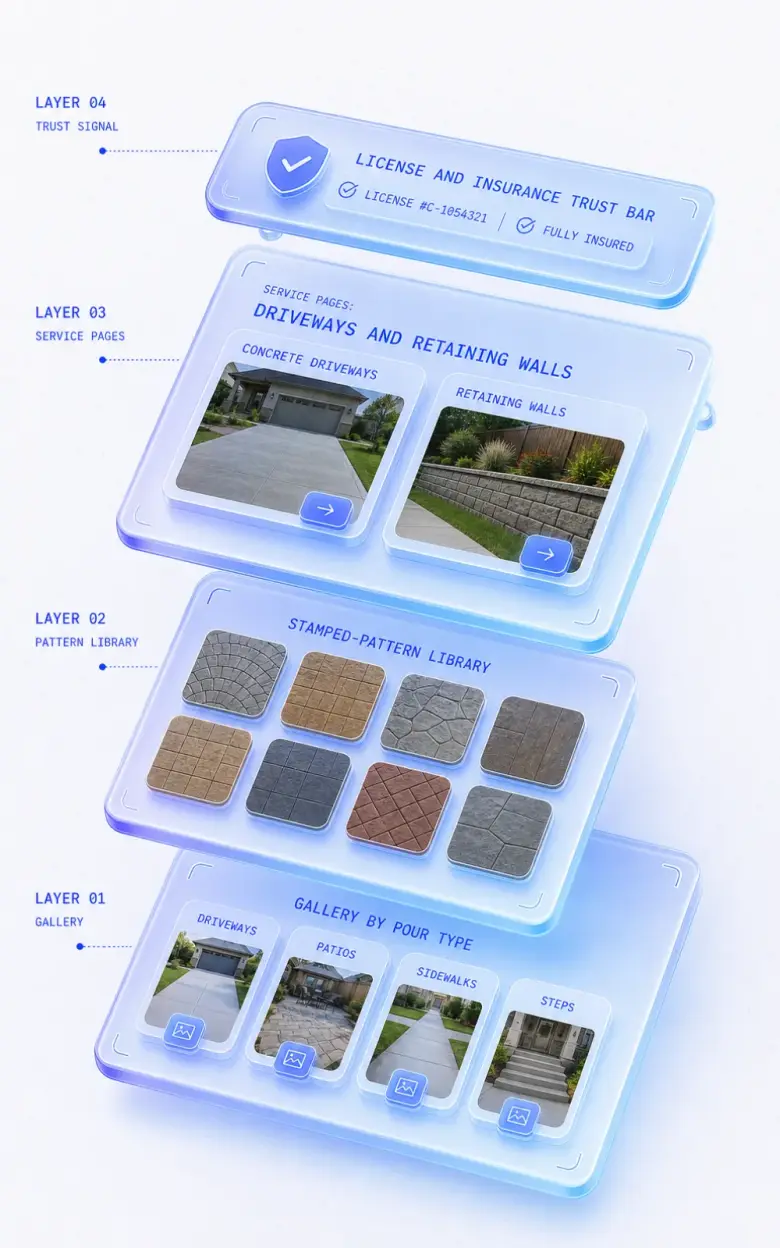
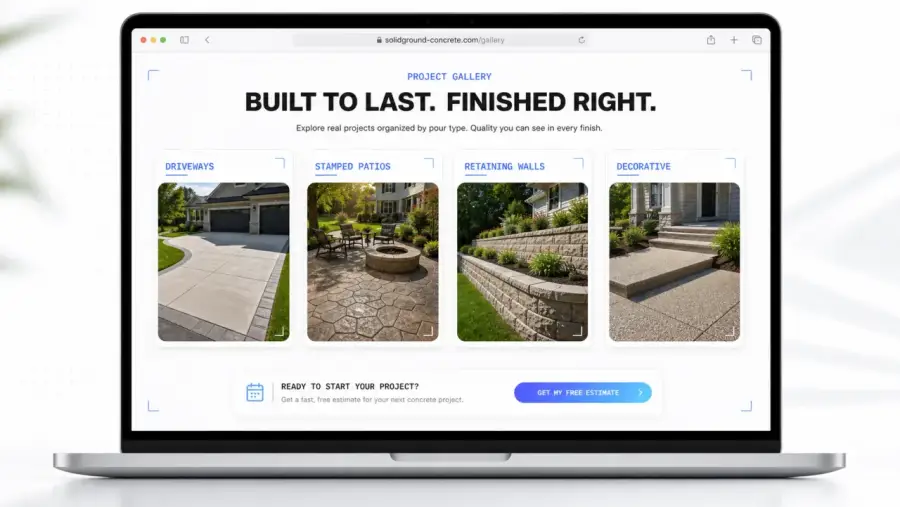
Project Gallery Organized by Pour Type

Driveways, patios, sidewalks, stamped concrete, decorative/exposed aggregate, retaining walls, pool decks, foundations. Customers click straight to their project type. Photo volume matters more than in any other trade.

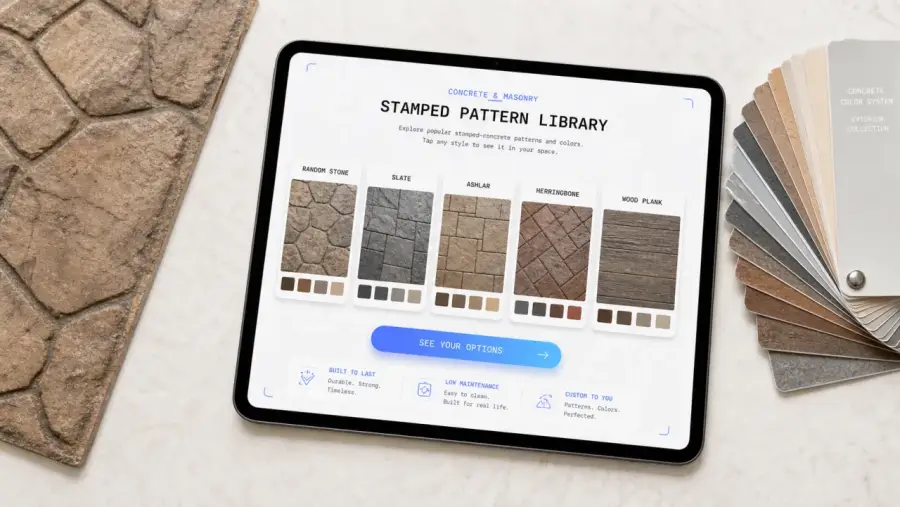
Stamped and Decorative Pattern Library

If you do stamped, decorative, or stained concrete, a page showing the patterns and colors you offer is one of the strongest-performing pages on the site. Customers want to see options before they call.

Service Pages by Pour Type

Concrete driveway installation, stamped patio installation, retaining wall installation, sidewalk replacement, concrete repair, decorative concrete, exposed aggregate, foundations, brick and stone masonry. Each gets its own page.

Material and Finish Education Section

A page or section that explains concrete vs. pavers, broom-finish vs. exposed aggregate, integral color vs. stains, sealing options, expansion joints. Customers researching $8,000 patios appreciate education and convert higher because of it.

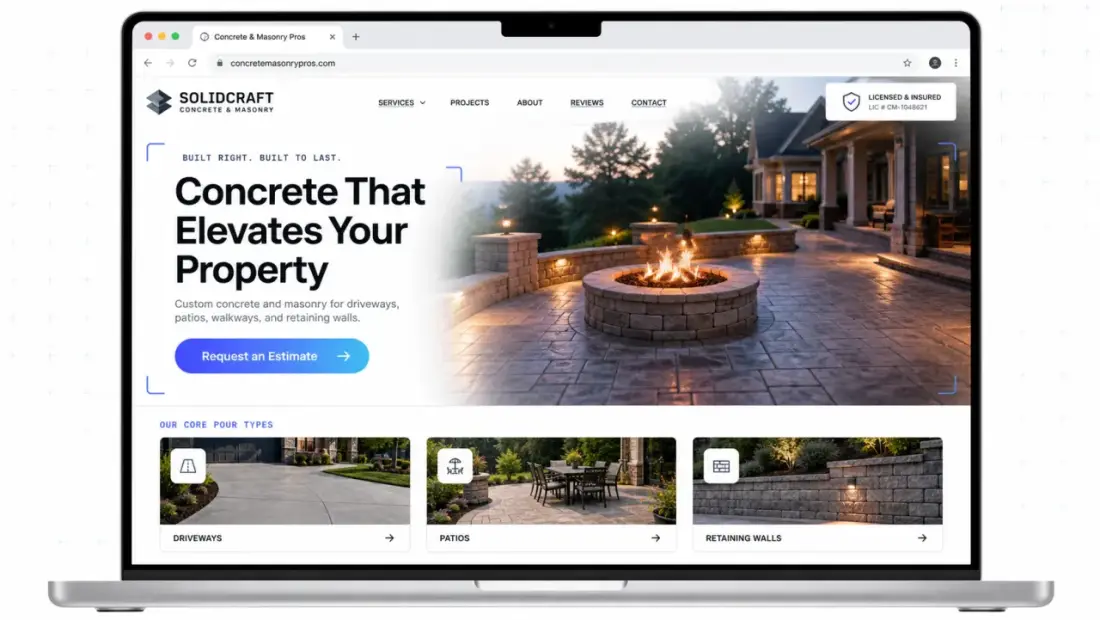
License, Insurance, and Year Founded

Contractor license number, liability and workers’ comp insurance, years in business. These are visible in the header and on every service page. Required for serious concrete buyers.

Free Estimate Form With Photo Upload

Customers can upload photos of their existing driveway, patio, or wall location for a more accurate initial estimate. Reduces in-person visits for unqualified jobs and speeds the sales cycle.

Service Pages That Help You Rank for Searches That Actually Convert

Concrete and masonry searches split sharply by project type. Customers Google what they want built, not who they want to call:

  • Concrete driveway installation [city]. Highest-volume premium category. Average $4,000-$10,000.
  • Stamped concrete patio [city] / stamped concrete contractor. Premium category. $5,000-$15,000+. Specialty visual work, high margins.
  • Retaining wall installation [city]. Tends to be one of the strongest-performing pages on a concrete site — customers Googling this term are almost always near hiring. Wide range: $2,000-$25,000+.
  • Concrete patio installation [city]. Bread-and-butter residential. $3,000-$10,000.
  • Sidewalk repair / concrete repair [city]. Lower-ticket entry point. Often leads to driveway-replacement conversations.
  • Decorative concrete / stained concrete [city]. Specialty visual category. Customers research for weeks.
  • Pool deck installation [city]. Premium category often paired with stamped or decorative finishes.
  • Foundation repair [city]. If you do foundation work. High-stakes, premium pricing.
  • Brick and stone masonry [city] / mason contractor. Different audience from concrete, often. Page should distinguish wet-laid masonry from concrete work.
  • Commercial concrete [city]. GCs, property managers, municipal. Different audience, different trust signals.

Local SEO for Concrete and Masonry Companies: How We Set It Up

  • GeneralContractor + LocalBusiness schema with concrete specialty. Tells Google your service area, services, and license info.
  • Service-specific title tags. “Stamped Concrete Patio in [City] — Free Estimates” instead of generic “Services.”
  • NAP consistency. Identical across the site, GBP, Yelp, BBB, and concrete-specific directories (ICPI, ASCC member listings if applicable).
  • Image-heavy structure. Galleries are compressed and alt-tagged with pour type and location. Concrete drives a non-trivial amount of total traffic through Google Image search.
  • Service-area pages. One page per town with mention of local soil conditions, climate considerations, and common project types in that area.
  • Speed and mobile readiness. Photo-heavy galleries optimized for fast mobile load.
  • Internal linking across services. Driveway page links to repair page, retaining walls link to grading, decorative work links to patio installation. Customer journey mapped into navigation.

What a New Concrete Website Is Actually Worth

Here’s a simple illustration (not a prediction — your results depend on your market, reviews, pricing, and many factors outside the website). The math on concrete is dramatic. If the website brings in one extra driveway per quarter at $7,000 and one extra stamped patio per quarter at $9,000, that’s $64,000 a year in incremental revenue. Add a retaining wall a quarter at $8,000 and the number climbs to $96,000+. Add the occasional commercial sidewalk job or foundation repair and you’re past $150,000 in additional yearly revenue. The $100 build and $25/month maintenance is a rounding error against numbers that big.

The premium jobs — stamped, decorative, retaining walls, commercial — come almost entirely from the website rather than referrals. Those customers research extensively before calling. A polished site with strong photos is the cost of being in the conversation.

Why Most Web Designers Overcharge Concrete Contractors

Agency quotes for concrete websites typically run $3,500 to $10,000 plus $100 to $300/month. The premium is justified by “custom design” and “SEO included” — in practice usually a template recolored with your brand and a monthly status report. The pricing is set by what concrete contractors are used to paying given their job sizes, not by what the work costs.

We do it differently. $100 build, $25/month hosting and maintenance, month-to-month, no contract. Free homepage mockup first. Custom concrete-specific tools — project calculators, color/pattern configurators, photo upload intake — are quoted separately and only when you ask.

Frequently Asked Questions

How many project photos should the site have?
As many as you can supply — concrete is the most photo-heavy trade. We aim for 60-100 photos at launch, organized by pour type. Each premium category (stamped, decorative, retaining walls) gets its own gallery.
How does the site target “stamped concrete patio near me” searches?
Stamped concrete pages tend to have less SEO competition in this trade because most established concrete companies haven’t built dedicated pages for it. A focused stamped page, a clear pattern library, and proper LocalBusiness schema give Google clean signals about that service — actual rankings still depend on competition, reviews, and factors outside the website.
Can we display the stamped patterns and colors we offer?
We recommend it strongly. A pattern library page (random stone, slate, ashlar, herringbone, wood-plank, and color variations) tends to be one of the strongest-performing pages on a concrete site. Customers want to see options.
How do you handle commercial vs. residential customers?
Separate sections with different copy, photos, and proof points. Commercial buyers want insurance, bonding capacity, and prior commercial work. Residential buyers want photos in homes that look like theirs.
Will the site help with retaining wall and foundation work specifically?
Both get their own dedicated pages. Retaining wall pages tend to rank quickly because the searches are very specific. Foundation repair is more competitive but high-ticket; we structure the page to capture both repair and new-construction searches.
Can the site display before/after concrete repair photos?
Concrete repair before/after photos are particularly persuasive because the visual transformation is dramatic. Replacing a settled walkway or cracked driveway looks immediate and obvious in photos.
How long until the new site produces leads?
Branded searches and Google Business Profile clicks can drive direct visits as soon as the site is live. Organic search rankings take time to build and depend on factors outside the website itself, including reviews, citations, and your Google Business Profile. SEO timelines are typically measured in months, not days, and we can’t promise specific rankings or traffic. Specialty pages (stamped, retaining walls, decorative) often face less competition because the competition is narrower.

Get a Free Homepage Mockup

We’ll design a free homepage mockup for your concrete & masonry business before you pay.

Get My Free Homepage Mockup See Pricing

See a Live Sample

View a sample website built for this kind of service business.

View Sample Concrete Site →
$100
Starting build fee
$25
Monthly hosting & maintenance
1–2
Weeks to launch

Let’s Build Your Concrete & Masonry Website

Send the basics and we’ll be in touch with next steps for your free homepage mockup.

Tell Us About Your Business