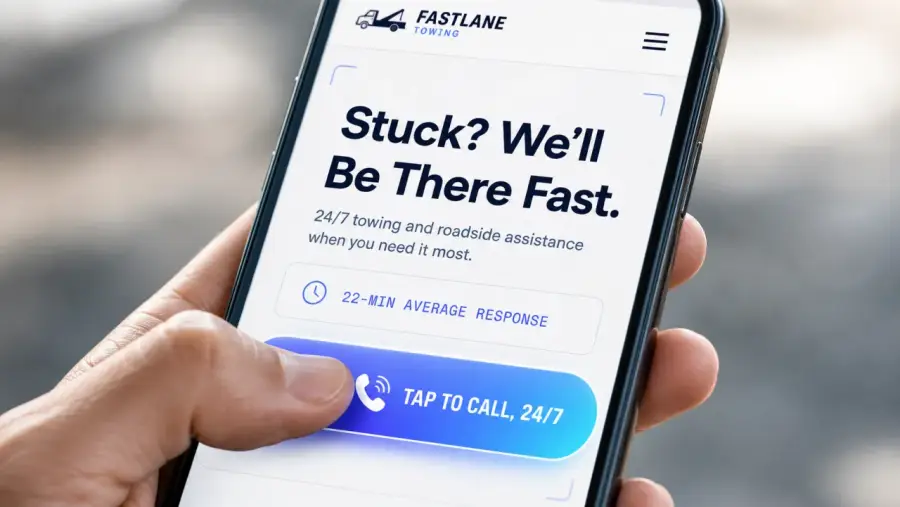
Tap-to-call
One giant tap and the phone rings
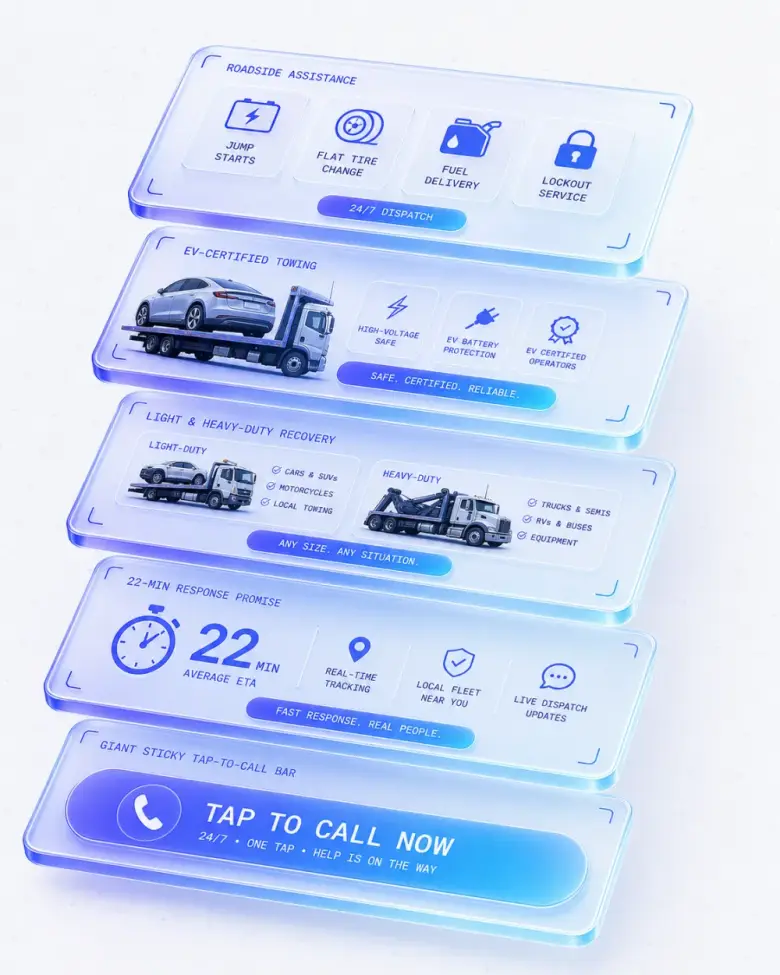
Your number in the header, the hero, every service page, and a sticky mobile bar, with a 24/7 promise. No copying, no squinting. It’s the most important button on a towing site.
Websites that win local customers
Towing is the highest-urgency search in the service economy: stranded driver, dying phone, 60-second decision. We build tow company websites with sub-2.5-second mobile load, sticky click-to-call, response-time promises ("22-minute average"), dedicated pages for light-duty, heavy-duty recovery, EV-certified towing (Tesla, Rivian, Lucid), motorcycle, roadside assistance, and the trust signals AAA and insurance partners need to put you on a contract.
● From $250 · live in 1–2 weeks · no contracts · you own it
See a towing site we built →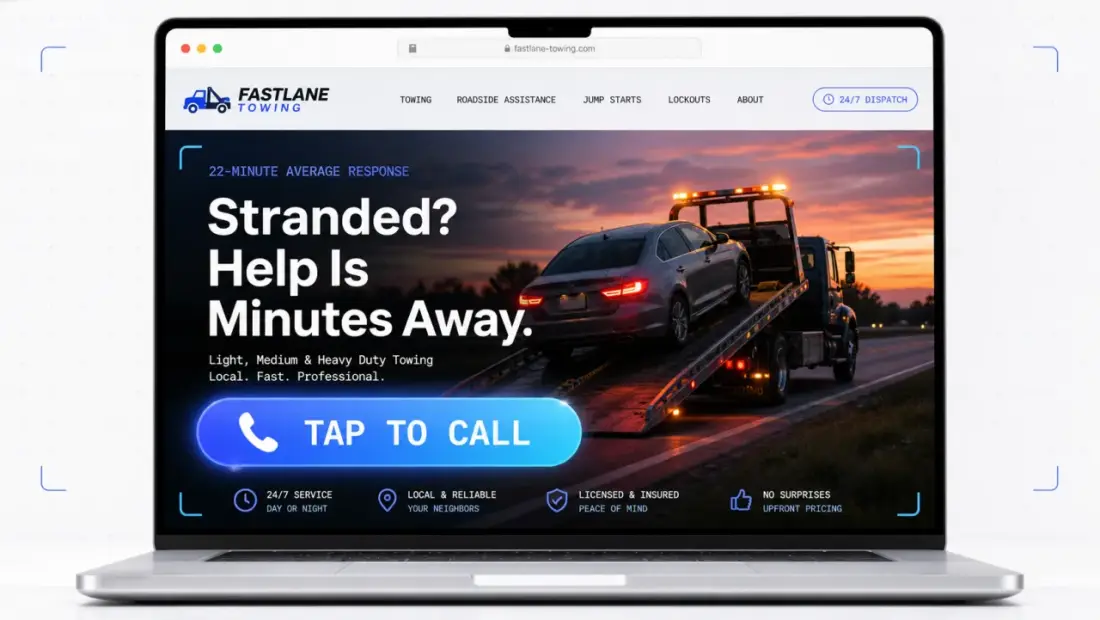
The search moment
Towing is the highest-urgency search there is: stranded driver, dying phone, no patience for a slow page. A fast, mobile-first website puts you in front of them at that exact moment: a giant tap-to-call button, the services you run, and a clear promise that help is on the way. That’s how a good site turns a roadside search into a dispatched truck before the competition even loads.
Fastest to load, easiest to call. That’s who gets the job.
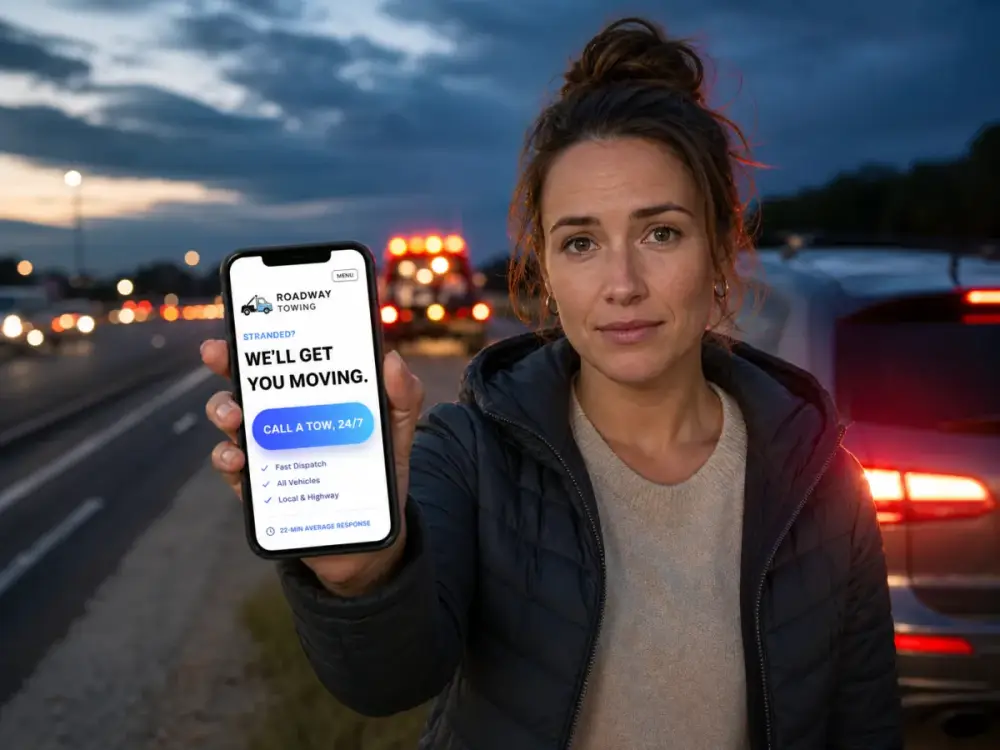
Breakdown → Search → Tap-to-call · the whole decision takes under a minute
What we build in
Not decoration. These are the pieces that get a stranded driver to call in seconds and give partners the proof to put you on contract, built into every towing website we ship.
Your number in the header, the hero, every service page, and a sticky mobile bar, with a 24/7 promise. No copying, no squinting. It’s the most important button on a towing site.
“On scene in under 30 minutes.” A clear response time answers the one question every stranded customer has, and gives them the confidence to call you.
Light-duty, heavy-duty recovery, flatbed, motorcycle, accident recovery, jumpstarts, lockouts, fuel delivery, winch-outs, with room for service pages as your site grows, each built around the exact service searched for.
One of the fastest-growing categories, with wheel-lift and flatbed methods for the EVs owners search by name: Tesla, Rivian, Lucid, F-150 Lightning.
Fleet photos, insurance, certifications, and your Google rating shown where partners can’t miss them: the proof AAA and insurers vet before a contract.
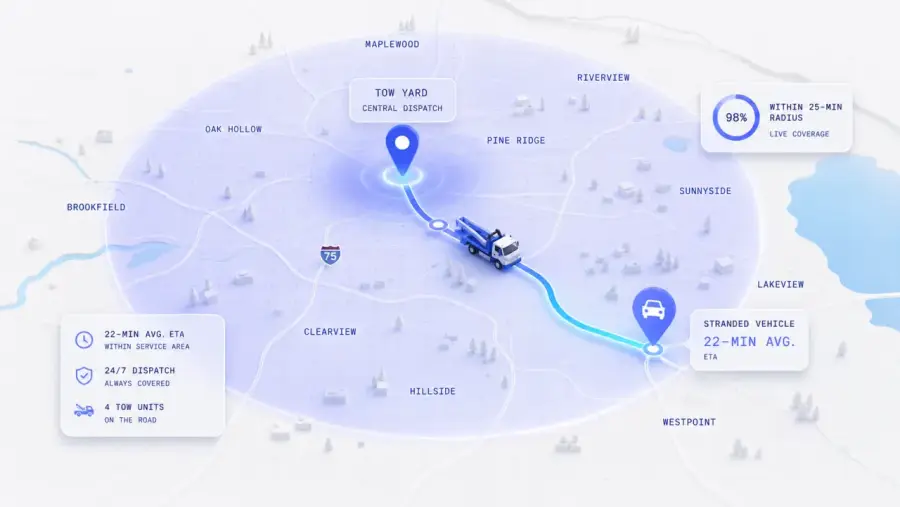
A visual map of your dispatch area, structured so Google understands where you work. Customers confirm you cover their location, and you show up for “tow truck near me” nearby.
Built around real searches
Towing searches split sharply by situation. A dead battery is not a heavy recovery. We give the services you prioritize their own page, as many as your plan includes, so you show up for the exact call a driver is trying to make.
The 24/7 “tow truck near me right now” searches, ready to tap-to-call.
Cars and light trucks, your everyday bread-and-butter dispatch.
Buses, rigs, and big recoveries: high-ticket work vetted before the call.
Damage-free transport customers ask for by name for prized vehicles.
Tesla, Rivian, and Lucid owners searching for the right method.
Urgent, high-stakes searches often tied to insurance and police calls.
Jumpstarts, lockouts, fuel delivery, tire changes: fast, frequent jobs.
A specialty search from riders who need careful, proper handling.
Interstate and out-of-town hauls: a considered, higher-value booking.
What’s built in
Plenty of websites look fine and still don’t work. Every towing site we build ships on the same engineered foundation. Here’s the standard spec, in plain English.
Fast-loading pages keep visitors engaged and make a strong first impression.
A flawless experience on phones and tablets, where most customers will find you.
Optimized so search engines understand your site and can connect you with local customers.
Organized around your services and service area, helping nearby customers find you.
Clear navigation so visitors instantly find your services, pricing, and contact details.
A polished, professional design that builds instant trust and credibility.
Designed to guide visitors toward calling you or requesting a quote.
Standard on every build, from the $250 starter to the largest package
How it works
Five calm steps. You hold the green light the whole way.
Tell us about your towing business: your services, your town, and what you need. No commitment.
FreeLove the direction? Give us the green light. Want changes? We revise first.
Your callWe build the full website: fast, mobile-first, and search-ready.
7–14 daysWalk through the finished site with us; we fine-tune the details together.
IncludedWe take it live, then keep it updated and running smoothly.
Status ● livePricing
One-time build. Pick the size that fits your towing business, from a simple starter site to a larger multi-page build. Every size sits on the same fast, SEO-ready foundation, so you can start small and add pages as you grow.
Every plan includes on-page SEO, mobile-first design and click-to-call. Hosting & care is optional at $25–$60/mo. Cancel anytime, and you own the site either way.
Questions
Instantly. Your number sits in the header, in the hero, at the bottom of every service page, and on a sticky mobile bar that follows the customer as they scroll: one tap to call, no copying or squinting, with a 24/7 promise up front. For towing, where the driver is stranded and their phone is dying, that tap-to-call is the single most important element on the site.
You can. Light-duty towing, heavy-duty recovery, motorcycle towing, flatbed, accident recovery, jumpstarts, lockouts, fuel delivery, tire changes, winch-outs, and long-distance tows can each get their own page, built around the exact service a customer searches for. You prioritize the services that matter most, with room to add more pages as your plan grows.
Yes, and it’s some of the most effective copy on a towing site. “22-minute average response” or “on scene in under 30 minutes” answers the one question every stranded customer has and gives them the confidence to call you instead of the next result.
With its own page. EV towing is one of the fastest-growing tow categories, so the page covers wheel-lift and flatbed methods and names the vehicles owners search by (Tesla, Rivian, Lucid, F-150 Lightning) so premium EV-tow customers see you handle their vehicle the right way.
That’s what the trust section is for. Your fleet photos, insurance, certifications, coverage area, and Google review rating are laid out clearly: the proof AAA, motor clubs, and insurance partners vet on paper before they add you to a contract.
Builds start at $250, and you pick the number of pages that fits: a simple starter site or a larger multi-page build. Every plan includes on-page SEO. Optional hosting and care runs $25–$60/month, and you own the site either way.
Why us
Towing is the highest-urgency search there is: stranded driver, dying phone, 60-second decision. We build for that exact moment.
Get started
Your next customer is searching this week. Tell us about your towing business and the town you serve, and we’ll take it from there.
Tell us about your business and the plan you’re interested in. We’ll reply within one business day with next steps. No payment is taken now.
You’ll see the design direction early, before you commit. No payment is taken now.