Web Design for Flooring Companies
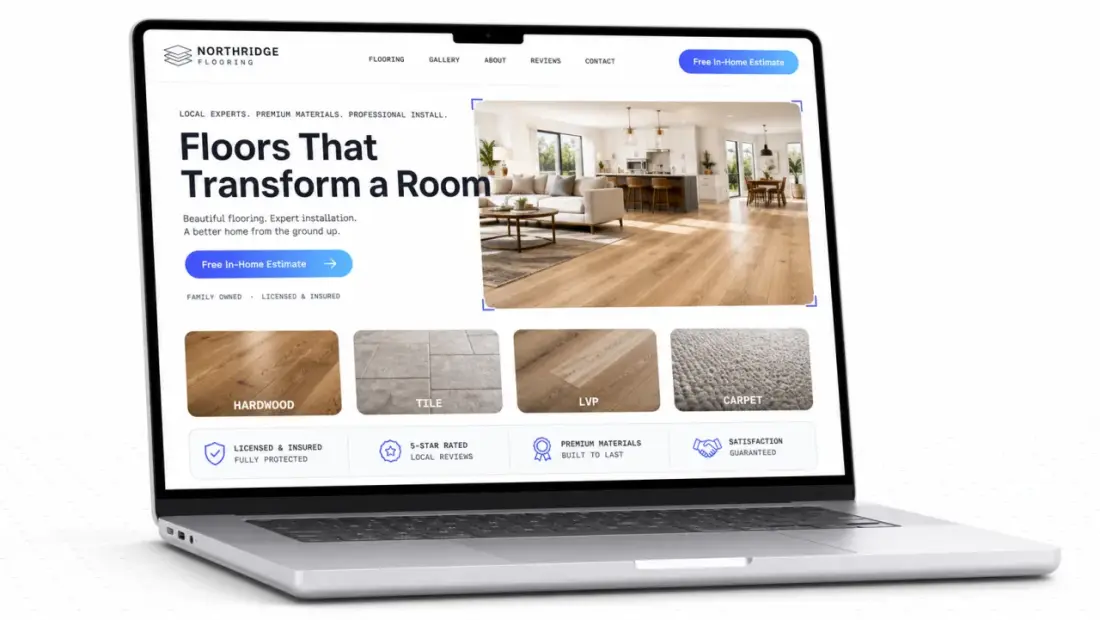
Flooring customers decide on material before they shop installers — they Google "hardwood floor installer" or "LVP installation," not "flooring company." We build flooring websites with dedicated pages per material (hardwood, tile, LVP, laminate, carpet), refinishing and repair pages, per-square-foot pricing ranges, install portfolios that prove finish quality, and the brand authorizations (Shaw, Mohawk, Mannington) that close premium installs. Built for $100. $25/month for hosting and maintenance.
Flooring Customers Shop Material Before They Shop Contractor
A homeowner buying new floors has usually decided what material they want before they Google a single installer. Hardwood, tile, luxury vinyl plank, laminate, carpet — the material decision happens at the showroom, on Pinterest, or in conversation with a builder. By the time they search for installation, they’re typing “hardwood flooring installer near me,” “LVP installer [their city],” or “tile contractor [their suburb].” If your website doesn’t have a dedicated page for each material you install, you don’t show up in the searches that actually convert.
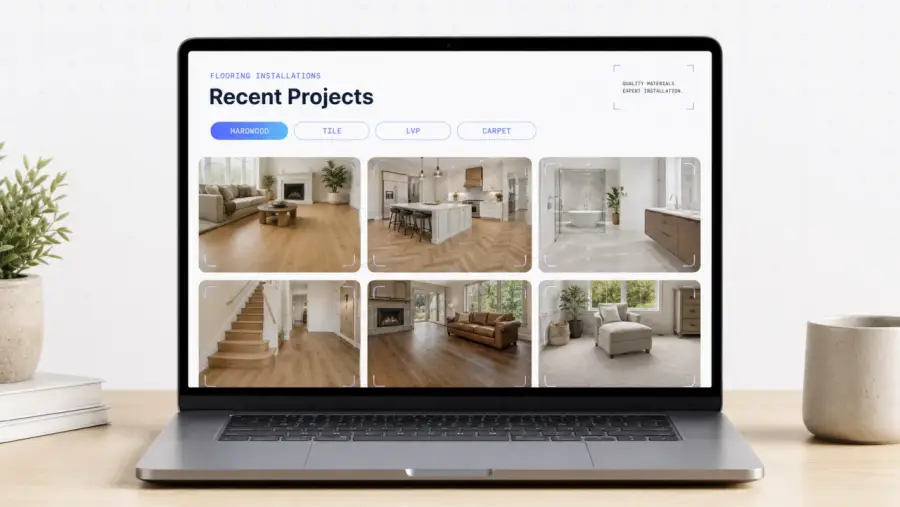
Flooring is also one of the most install-quality-sensitive trades a homeowner hires. A bad install ruins an expensive material. Customers want to see finished install photos — not just product photos — before they commit. They want to see your transitions, your stair nosings, your tile cuts, your hardwood seams. Your website’s project gallery is the single most-important sales tool you have, more important than your showroom for the customers who research online first (which is most of them).
And then there’s the average ticket size: a typical whole-home flooring job runs $5,000 to $25,000+. Customers shopping these dollar amounts get 3-4 estimates and read every review they can find. Your website is the gatekeeper to that estimate appointment.
What Happens When Your Flooring Business Has No Real Website
- You don’t make the bid list for big jobs. $10,000+ flooring projects involve 3-4 contractor comparisons. Without a website with finished install photos, you’re excluded from the bid list before you knew you were in it.
- You miss material-specific search. Customers don’t Google “flooring company.” They Google “hardwood floor installer” or “LVP installation [town].” Without dedicated material pages, you don’t exist.
- You can’t prove install quality. Photos of transitions, tile work, hardwood seams, and stair installs are what close the bid. Facebook buries this; a website features it.
- Builders and designers can’t find you. Custom home builders, remodelers, and interior designers source flooring installers online. Without a real website with commercial-grade trust signals, you’re not in their vendor pool.
- You can’t charge premium for premium materials. $8 per square foot exotic hardwood installation requires a customer who’s convinced you can install it correctly. That conviction comes from a website — not a Facebook page.
What Customers Actually Want to See on a Flooring Website
Project Gallery Organized by Material
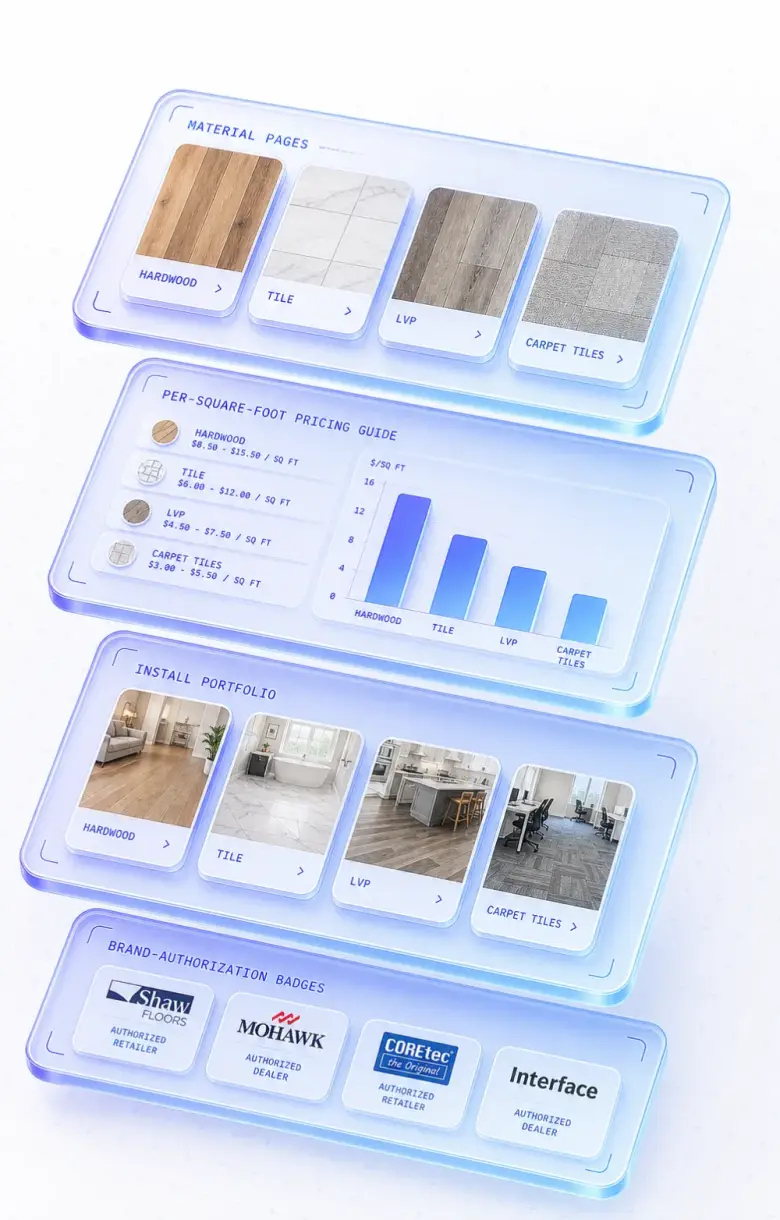
Hardwood gallery, tile gallery, LVP gallery, carpet gallery, laminate gallery. Within each, sub-styles (wide-plank oak, hexagon tile, herringbone LVP). Customers click straight to their style.
Service Pages by Material Type
Hardwood floor installation, hardwood refinishing, tile installation, LVP installation, laminate installation, carpet installation, stair installations, transition and trim work. Each gets its own page.
Material Comparison and Education Section
Side-by-side comparison of hardwood vs. LVP vs. laminate vs. tile vs. carpet: durability, water resistance, lifespan, maintenance, install cost ranges. Customers who land here usually convert within 2 weeks.
Pricing Per Square Foot Ranges
“Hardwood install: $X-$Y per sqft.” “LVP install: $X-$Y per sqft.” Customers want a ballpark before requesting an in-home measurement. Published ranges out-convert “call for pricing.”
Brands and Suppliers
If you carry specific brands or work with regional suppliers (Shaw, Mohawk, Mannington, Hallmark, Provenza), display them. Brand recognition matters more than independent flooring installers often realize.
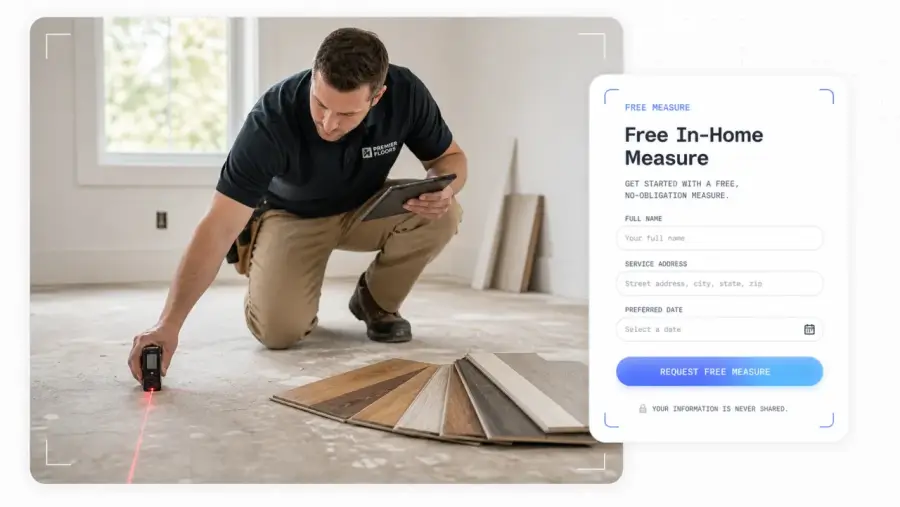
Free In-Home Measure Form
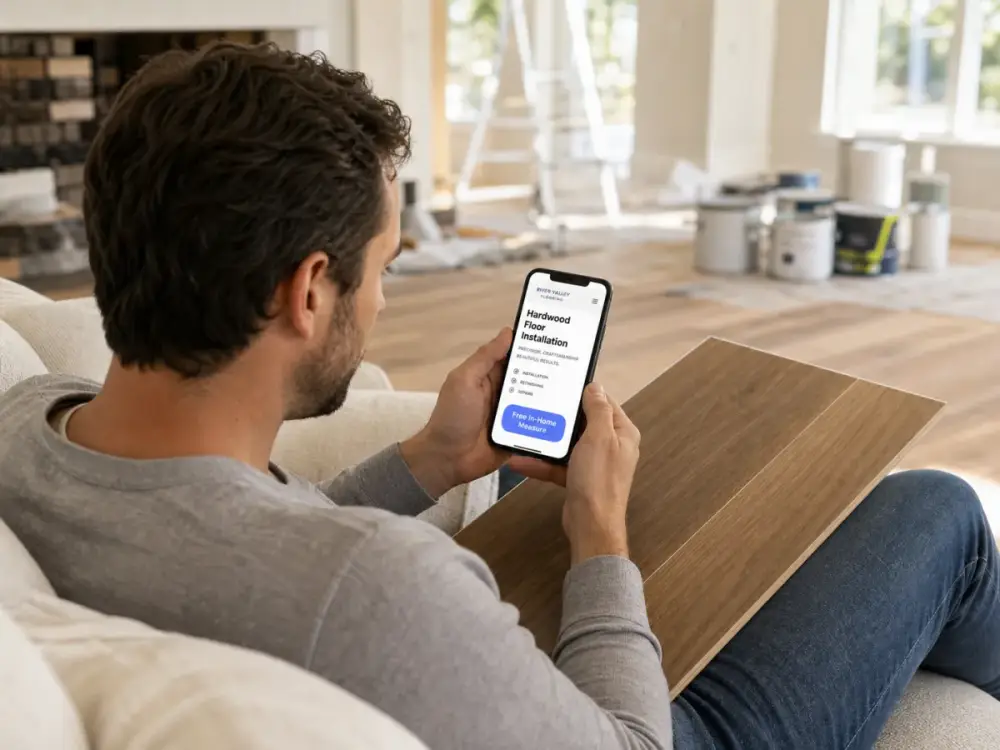
Short form: address, rooms, material interest, timeline. Triggers an in-home measure appointment scheduling sequence. Most flooring measures are free — say so prominently.
Service Pages That Help You Rank for Searches That Actually Convert
- Hardwood flooring installation [city]. Premium category. Average $5-$12 per sqft installed. Customers research extensively.
- Hardwood floor refinishing / sand and refinish [city]. Cost-effective alternative to replacement. $3-$8 per sqft. Often the entry point before larger installs.
- LVP flooring installation [city] / luxury vinyl plank. Fastest-growing flooring search category. $3-$7 per sqft installed.
- Tile installation [city] / ceramic tile installer. Premium specialty, often paired with bathroom remodel work. $7-$15+ per sqft.
- Carpet installation [city]. Lower per-sqft but high volume. Often paired with hardwood for high-traffic vs. bedroom areas.
- Laminate flooring installation [city]. Budget-conscious customers. Often the entry point before LVP conversation.
- Engineered hardwood installation [city]. Premium category for below-grade and slab installs.
- Stair installation / stair refinishing [city]. Specialty work with premium pricing.
- Commercial flooring [city] / commercial carpet / commercial LVT. Different audience entirely.
- Floor repair / hardwood repair [city]. Lower-ticket entry point.
Local SEO for Flooring Companies: How We Set It Up
- FlooringContractor + LocalBusiness schema. Service area, materials offered, and service list.
- Material-specific title tags. “Hardwood Flooring Installer in [City]” instead of “Our Services.”
- NAP consistency. Identical across the site, GBP, Yelp, BBB, Angi, and flooring-trade directories.
- Image-heavy optimization. Project galleries compressed and alt-tagged. Image search drives significant flooring traffic.
- Service-area pages with material specificity. Each town page mentions material types popular in that area (e.g., LVP popular for slab homes, hardwood for older neighborhoods).
- Speed. Heavy galleries lazy-loaded so the page stays fast.
- Internal linking. Hardwood install page links to refinishing, refinishing links to repair, repair links to staircase work. Customer journey mapped.
What a New Flooring Website Is Actually Worth
Here’s a simple illustration (not a prediction — your results depend on your market, reviews, pricing, and many factors outside the website). If the website brings in one extra whole-home flooring job per month at an average ticket of $8,000, that’s $96,000 in incremental annual revenue. Add one extra tile bathroom per quarter at $4,000 and one extra refinishing job per quarter at $3,000 and you’re past $130,000. Even modest results easily cover the $100 build and $25/month maintenance.
The premium jobs — wide-plank hardwood, custom tile, commercial LVT — come almost entirely from website research. Customers spending $15,000+ on flooring do their homework before they call.
Why Most Web Designers Overcharge Flooring Contractors
Agency quotes for flooring sites typically run $3,000 to $8,000 plus $100 to $300/month. The pricing is set by what flooring companies are used to paying, not what the work costs.
We do it differently. $100 build, $25/month hosting and maintenance, month-to-month, no contract. Free homepage mockup first. Material catalogs, color/grade configurators, and showroom integrations are quoted separately and only when you ask.
Frequently Asked Questions
How many project photos should be on a flooring website?
How does the site target material-specific searches searches?
Should I publish per-square-foot pricing?
Can the site display the brands and suppliers I work with?
How do you handle the in-home measure appointment flow?
Will the site handle commercial flooring?
How long until the site produces leads?
Let’s Build Your Flooring Website
Send the basics and we’ll be in touch with next steps for your free homepage mockup.
Tell Us About Your Business